
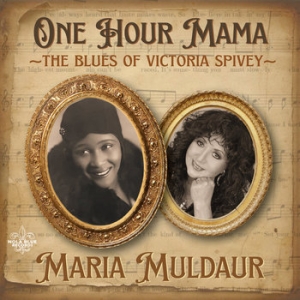
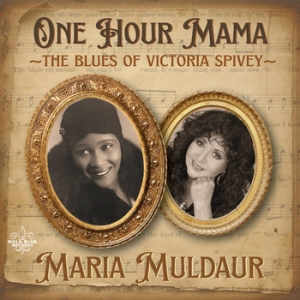
One Hour Mama: The Blues of Victoria Spivey by Maria Muldaur
 I have a long history with Maria Muldaur. It begins with the Even Dozen Jug Band; my older brother gave me an LP of that band which had twelve men and Maria D’Amato. You might recognize some of the other names in that band: Peter Siegel, Stefan Grossman, Bob Gurland, David Grisman, Fred Weisz, Josh Rifkin, Steve Katz, Danny Lauffer, Pete Jacobson, Peggy Haines, Josh Benson, Frank Goodkin. They all appear on the LP, but John Sebastian, who does not, was also in the band. Maria tells the story of how she came to join the band in the liner notes of this CD. Although the LP was released by Elektra in 1963, they had bought it from Spivey Records, which was owned by Victoria Spivey, who was a legendary blues diva who had begun recording in 1926. Maria reports that Ms. Spivey took her under her wing and coached her in many areas, including how to dress on stage. Maria only appears on two tracks of the album, both as second voice on “Overseas Stomp” and “Come On In.”
One of the largest record stores in New York in the 1960s was Sam Goody’s. When stereo LPs came out, they opened a store across the street to sell all their monaural LPs. I bought five, all on the Prestige Bluesville label. Three were by Lonnie Johnson. One was by Victoria Spivey, and the fifth was the two of them together.
In about 1966, when I was a student at Columbia, I noticed a bluegrass jam on the lawn in front of my dormitory. I brought my banjo to it and sat down. Pete Wernick was playing banjo. David Nichtern, who later wrote “Midnight on the Oasis” was playing guitar. A few minutes later, an incredibly beautiful woman arrived with a fiddle. It was Maria D’Amato. Maria went on to Boston to play with the Jim Kweskin Jug Band and to marry Geoff Muldaur and become Maria Muldaur.
In 1996, I was at a Folk Alliance conference in Washington, DC listening to a wonderful jam with Hazel Dickens, Alice Gerrard, Ginny Hawker, and Kay Justice singing and Tracy Schwarz, Ginny’s husband, on fiddle. Sitting on my left was Kate Long, who had written “Who Will Watch the Home Place” and on my right was Peter Siegel. I asked Peter why Maria did not sing much on the LP. He told me that the recording engineer told them that her voice did not sound good through a microphone. Maria has obviously proven that engineer wrong.
Fast forward a few years, and I found myself at a party at Eric and Suzy Thompson’s house. Maria and I were sitting in the kitchen playing Gaither Carlton tunes, me on banjo and her on the fiddle. Maria had gone to North Carolina in the 1960s to visit Gaither Carlton at home; he was Doc Watson’s father-in-law, and a fine fiddler. Suzy later joined us.
In May of 2026, I went to see Rambling Jack Elliott, who is now 95 but still sings well and plays the guitar, at the Freight in Berkeley. Maria was on the program and sang one of the songs on this CD, which I bought from her.
There are twelve tracks on the CD, and Maria recorded it with three different bands: James Dapogny’s Chicago Jazz Band, Tuba Skinny, and a third band, which is not named. Elvin Bishop duets with Maria on “What Makes You Act Like That?,” written by Lonnie Johnson; and Taj Mahal sings with her on “Gotta Have What It Takes,” which was written by Victoria Spivey and Harold Grey. Ms. Spivey also wrote “Don’t Love No Married Man,” “Dreaming of You,” “No, Papa, No!,” “Down Hill Pull,” “T-B Blues,” and “Funny Feathers,” which she cowrote with Reuben Floyd.
The CD opens with “My Handy Man,” full of double meanings and sexual innuendo. Next is the duet with Elvin Bishop, “What Makes You Act Like That?” The third track is “Don’t Love No Married Man,” which is full of advice and obvious experience. “Dreaming of You” is a classic love song. “Organ Grinder Blues” makes full use of the grinding metaphor. “It’s not your organ, it’s the way you grind.” “No Papa, No!” is an independent woman saying, “If you want my money, it’s something you ain’t ever done.” The title cut, “One Hour Mama,” is sung by a woman who is in no hurry and knows exactly what she wants. The feathers in “Funny Feathers” belong to a rooster who rules the roost. Next is the duet with Taj Mahal, “Gotta Have What It Takes.” She is telling him that he doesn’t measure up as he objects. “Any-Kind-of-Man” was written by Hattie McDaniel, a contemporary of Victoria Spivey’s who won an Oscar as best supporting actress playing Mammy in “Gone with the Wind.” The theme is similar to the last one; the man isn’t good enough. “Down Hill Pull” is a lament about an unsatisfying relationship which is also ending. “T-B Blues” ends the album. It’s another lament about being abandoned by friends as you’re dying of tuberculosis. “This T-B’s killing me.”
Maria is in very fine voice, and all three bands are wonderful. The album was nominated for a Grammy. It is a very fitting tribute to Victoria Spivey, and that is intended to be high praise.
Released July 11, 2025. Available here.
Here is Victoria Spivey singing T. B. Blues in 1963.