
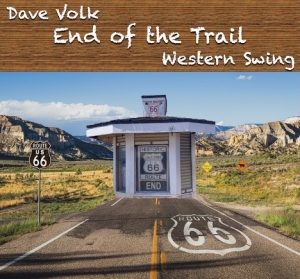
End of the Trail by David Volk
Great new Western Swing Album!
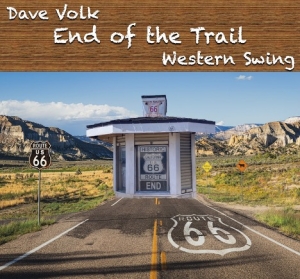 The western swing album End of the Trail by Southern California guitarist and singer David Volk was my favorite release of 2025. Surprising for a half-hour record in a niche genre that has not exactly dominated the streaming economy? But here it is. The album has eight songs, all of them well known, all of them recorded many times, and yet it stands with the best western swing recordings I know. I have owned plenty of western swing CDs from the era when one still accumulated such things on shelves. I put End of the Trail at the top of the list and if someone wanted an introduction to western swing, this would be my recommendation.
Western swing was one of the more successful American musical hybrids: a style that took string-band fiddle music, blues, pop songs, jazz phrasing, cowboy imagery, and dance-hall rhythm and persuaded them to work together. It emerged in Texas and Oklahoma in the 1930s and reached its height in the 1940s. Nationally, it never competed well against big-band swing, but regionally it mattered a great deal. In parts of Texas, Oklahoma, and California, it was the popular music and definitely the dance hall leader. By the late 1940s, it started to fall out of fashion. Large bands cost money and tastes changed. It never quite disappeared, though much of what came later was either revivalism or tribute.
Bob Wills casts a long shadow over the genre, and over this record. Most of the songs on End of the Trail were in his repertoire and many have been recorded again and again, often by people who seem to think the main lesson of western swing is that someone should yelp regularly “ah – ha.” (Bob Wills’ trademark was to fill his band’s performances with high-pitched shouts and running commentary.). Dave Volk does not reenact these idiosyncrasies. These are great arrangements performed expertly. The opening of Route 66 is brilliant. Hard to describe, listen to it.
I’m an Old Cowhand is my favorite track. It is not originally a western swing song at all. Johnny Mercer wrote it in 1936 as a satirical comment on the already manufactured image of the singing cowboy, and Bing Crosby had a hit with it (and yet singing it in kind of western movie). Volk’s version gets the balance right. It understands the joke without overplaying it. Not only my favorite track of that recording, also my favorite version of this song among the many versions I know.
A good deal of the credit for arrangements belongs to Marty Rifkin, who produced the album and plays steel guitar on it. Great arrangements and production! I do not know the full personnel, only some: Gabe Witcher and Benny Brydern handle the fiddle parts, Chris Cerna plays piano and electric mandolin, and Ron Vance is on upright bass. There are other musicians as well. Whoever all of them were, they did a great job.
The track list is well chosen maybe faintly pedagogical? It begins with Miss Molly, a western swing standard associated with Bob Wills and the Texas Playboys. I’m an Old Cowhand comes from outside the genre and wandered in. Faded Love returns to the center of the Wills repertoire (before later becoming a country standard through Patsy Cline, Ray Price, Willie Nelson, Asleep at the Wheel, and many others). Route 66, written by Bobby Troup and popularized by the Nat King Cole Trio in 1946 (and later the Rolling Stones) also comes from elsewhere. Then it is back to Bob Wills territory with Deep Water, a less famous song than Faded Love but one I like a lot. See the pattern? One song from the western swing core, one from somewhere adjacent, then back again. Milk Cow Blues is blues territory and usually credited to Kokomo Arnold, who recorded it in 1934. I still associate it first with Elvis Presley, which probably says more about the afterlife of songs than about genre categories. Right or Wrong dates back to the early 1920s and became part of western swing through Bob Wills. The final track, Maiden’s Prayer, has the strangest ancestry of the lot, beginning as a 19th-century salon piece by the Polish composer Tekla Bądarzewska in the Russian Empire before somehow ending up as a country and western swing instrumental standard. It was dismissed as drivel when young and still very successful. Harsh criticism, but not inexplicable. I confess it is the one tune here I do not especially like.
What makes End of the Trail work is not novelty. What matters is judgment: the choice of material, the pacing, the feel of the band, and the refusal to turn the whole enterprise into a Bob Wills cosplay session complete with compulsory “ah-ha” yelps (you will find that on so many more recent Western Swing recordings). The album gives these songs space without fussing over them. It is not trying to outdo the past. It simply understands that these songs are still serviceable if played by people with taste.
End of the Trail by David Volk
Great new Western Swing Album!