

The Traditional Pottery of Richard Zane Smith
NUMBER 52 - Researching, creating, codifying into the next generation
October 2026

Richard Zane Smith‘s pottery thematically spans generations. I came to learn this is very intentional – he researches traditional techniques and patterns. He also brings a modern geometric sensibility into a lot of his work – I’m not the only one to say “m.c. escher.” Even so, the finest of his brushwork preserves the organic nature of the medium.
Richard’s Facebook page is full of his work and his work with others. He mentors people who come to him wanting to learn the path their ancestors started. He partners with other academics like Carrie Lind, codifying tribal history in pottery technique, language, and more.
We talked about bringing the past into the future through many routes, not just ceramics. But oh, how I love talking ceramics. It’s been a long time since I got my hands dirty in that way, and sometimes our conversation fell into shorthand.
deb Ewing (dE): Let’s start with this one: It’s a picture of you holding a blue pot, I think it says 1993, “The pot that cut a path to a life as a full-time pottery artist.”
Richard Zane Smith (RZS): You can tell by the look on my face: I had no idea that it was really meaningful. We were living in Ganado out on the Navajo res at the time, renting this old stone house by the lake. It had a little stone building on the side that I turned into a studio. Somebody mentioned that the Heard Museum had their annual thing. I thought, “Well, maybe I can make a sale.” So I did some of my very first large corrugated pieces. This one, the flashing turned out so nice.
dE: Explain the “flashing.”
“Flashing” refers to changes in the color, pattern, and texture of pottery. It occurs naturally during firing when clay comes into contact with flame, wood ash, or soda vapors. –Lesley, thepotterywheel.com
RZS: This was done in a mud kiln that I’d built. I just basically piled dry cow pies all around the pot till the pot was covered inside the kiln, and then brought the kiln up to temperature so the metal chimney was glowing about halfway up – then I knew I had temperature. That’s kind of what I went for until I started using cones (even though I found out later cones weren’t always that reliable either.)
In the meantime, I’d borrowed a thousand dollars from my brother-in-law and built a stoneware kiln; I was firing that traditional pot with wood that I cut. I got a phone call from one of the judges at the Heard Museum, who also happened to be a gallery owner. And he mentioned, “Who represents you?”
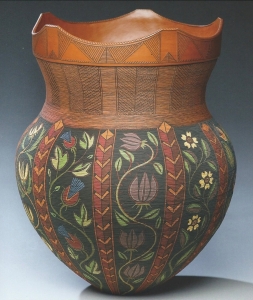
Traditional Iroquoian pot lip, body made in Pueblo style coiling
“Well, I don’t even know what that means.” I was about ten hours into throwing wood into that stoneware kiln, almost tempted to just quit. I had no idea I’d be able to make a living doing that. So I felt like I was at the right place at the right time. So one gallery kind of led to another gallery.
dE: It’s a relationship, right?
RZS: Yeah, exactly.
dE: So this pot – is this kind of a modern/traditional blend or is it more rooted in tradition?
RZS: The top of it is one of our types, ones they might call St. Lawrence Iroquoian, but the entire piece was built with a Southwestern technique of all the tiny coils.
dE: I was going to ask you that. They’re actually coils?
“Potters corrugate ceramic vessels by leaving the coiling method of construction exposed on the vessel exterior, only smoothing clay coils on the inside of the pot in order to hold it together.” –Genevieve Woodhead
RZS: Basically, all the horizontal lines you see there are showing the coils; that’s an old ancient Pueblo technique I picked up. For some reason, in the 1400s, that technique of building with coils that way – what they call the corrugated pots – sort of died out. There was a lot of trauma going on in the Southwest: droughts, and people were moving around trying to find water, and a lot of the Rio Grande Pueblo started increasing…the Hopi Mesas…the populations grew. I guess when you go to a new area, you kind of blend in. You have to be really careful about disrupting things. That’s my theory, anyway. The Acoma have tried to recreate a type of corrugated pottery. It’s a little different than mine. Their coils are bigger. They don’t flatten them quite as much as I do.
dE: Is there a function to the shape of that upper edge, or is it mainly decorative?
RZS: People ask that all the time; you can come up with ideas. I think, for one thing, setting pots upside down to dry out after they’ve been washed, like setting them on a tripod. Some of the Wyandot pots from way up north by Lake Simcoe have just two little tiny castellations on either side. But even that would keep a pot from setting flat and allow it to dry properly after it’s been washed.
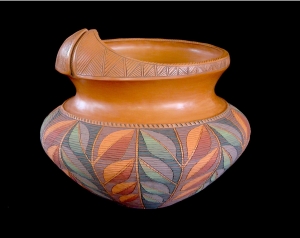
prow-shaped pot, Richard Zane Smith
dE: Okay, this prow piece, is that a traditional shape or is that something you came up with? Is that more modern, the prow?
RZS: It’s a traditional form that shows up in a lot of our old village sites. In some of them, the prow is actually a sharp edge and it goes straight up. Some of them look like they’re for almost like a spout, not quite, and then some are turned in like this. They go actually pointing backward. Nobody knows exactly what these pots were used for or what they were. I have some ideas – not very flattering, but I think that maybe some of these might’ve been used like “thunder mugs” in wintertime. A little boy’s got to pee and it’s cold in the long house…set them on one of those and point them in the right direction.
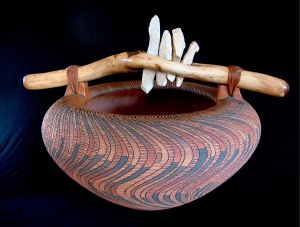
4-rock-handled piece, 2012, Richard Zane Smith
dE: On Facebook, you talked about this one: you said “the vessel was actually made to fit the handle representing the water in the creek below rocky roots still clinging to the banks.”
RZS: Yeah, these roots that are growing out of the side of the creek bank, they usually are embedded with rocks. The sycamores grow through the soil. It’s so rocky out here, and splints are sticking out of them. And then occasionally I’ll walk by and I’ll help them out. I’ll stick some stones that I find into the root and let it grow. So they’re squeezing the stones and then I’ll harvest them. So that’s a particular one that I’d done that with.
Read more about Richard’s pottery techniques here: Reach Back For Your Ancestors – Richard Zane Smith
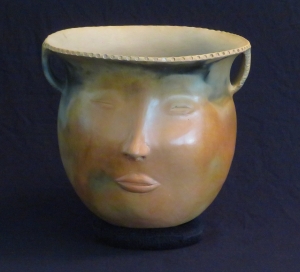
ceramic pot by Carrie Lind
dE: This is not yours, but I wanted to stop and talk about how amazing it is.
RZS: Carrie (Lind) – I’ve been mentoring her probably for almost 10 years now. She comes over when she can. She’s really passionate about learning.
dE: Is she coiling that?
Paddling is a ceramic modeling technique that consists of delicately striking a piece of clay with a flat tool, known as a palette, which can be made of wood, rubber or even metal. –smalted.com
RZS: She’s doing both; some coiling and some paddling. Usually, if we’re doing round-bottom pieces for cooking, we paddle over a form. We’ll call that a Grandmother form – you’re paddling over your mother’s or grandmother’s form of an old cooking pot, then that piece is turned over, set in a bowl, and from there the coils are built the rest of the way.
dE: I can’t imagine inheriting the form. That would be so cool.
RZS: Katsitsionni Fox, one of my students from Akwesasne, was able to get permission from one of the museums and to actually paddle clay to create a form from an original grandmother pot.
dE: It’s good that institutions are actually helping to carry on tradition. So let’s cycle back around to teaching. I’m assuming that young people are seeking you out to learn?
RZS: Yeah. And some of my best classes are those who are already involved in their culture deeply. They have their language, they have their life ways and they’re planting three-sister gardens. And so they feel like, “Well, there’s one thing we don’t really have, we’re not real strong on, and that’s our pottery tradition.” And somehow they’ve decided to come to me for some of that. It’s been really meaningful to me that I can be one to help with that, for them to actually find something they can take home.
But what I require for a workshop like that is three students who are going to be teachers. We each get a corner of the table that way. I’ll start with clay that’s already mixed because they have to make a pot before they go home. So I’ll have the clay mixed, they’ll make a pot or two the first couple of days. Then the next day we start processing clay. We might go dig clay and then bring it back and process it so they get that experience.
Then they start making their own tools. I want them to have some forms they can take home with them. At least one of their pots is a cooking pot, and that’s part of the thing too, bringing them back to where their ancestors left off.
We’ll have corn soup with traditional meats and milkweed or tea going all in pots that they’ve made and fired. And then we sit down and have a meal together and we usually close it with a Thanksgiving address – like we usually start, too. Those are the best classes because they understand how ceremony fits in. It’s not woo-woo.
dE: Ceremony is functional, too, right?
RZS: That’s right. Gratitude. It’s putting ourselves in a place of gratefulness. And when we think that way and start our day that way, it keeps us from letting the dark stuff come in and take over.
dE: They’re serious. I think I read that you’re only taking students who are on that path.
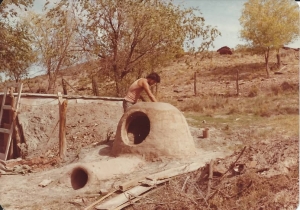
building the mud kiln
RZS: Right. They’re going to go back to their communities and they’re going to teach. I’m always there for them to ask questions. They can message me. They can say, “What was that thing? What was your percentage of clay and temper? What was that?” But it’s also one reason I’m saying, “You guys need to bring a videographer when we do this so your whole time here is recorded. Then you can put together your own film and add your own language, make it customized.”
When people start hoarding their knowledge, they start hiding secrets they’ve learned that could really help somebody who’s struggling, but they don’t want to help somebody get ahead of them. And I think we should be trying to find people who want to get ahead of us. I hope everybody can learn from what I’ve shared and do much more wonderful stuff than I’ve ever been able to do. I think to me, that would just be so awesome to know that.
Follow Richard Zane Smith on Facebook, Carrie Lind and Katsitsionni Fox on Instagram, but more importantly, reach back into your roots. Find your grandmother’s cooking pot form, whatever form it took, and understand it so you can teach the next generation.
Read the full interview on traditional pottery and teaching here: Reach Back For Your Ancestors – Richard Zane Smith
 debora Ewing writes, paints, and screams at the stars because the world is still screwed up. She improves what she can with music collaboration, peer-review at Consilience Poetry Journal (based in the UK), or designing books for Igneus Press. deb is on the editorial board for Berlin-based Beyond Words Literary Magazine. Follow @DebsValidation on X and Instagram. Read her self-distractions at FolkWorks.org and JerryJazzMusician.com.
The Traditional Pottery of Richard Zane Smith
NUMBER 52 - Researching, creating, codifying into the next generation
October 2026