
The Lopapeysa Sweater: a Book, an Adventure, a Guy and Some Needles
NUMBER 53 - How a Photographer toured Iceland and knit his own sweater by way of roller derby
November 2026
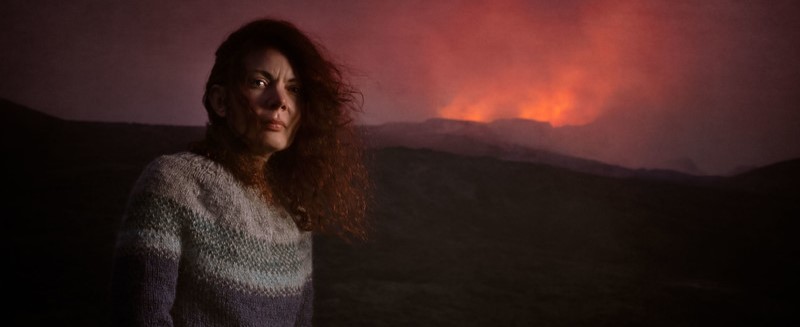
Trillian Stars, photo (and all photos in this article) by Kyle Cassidy
Kyle Cassidy (KC) is a phenomenal photographer and a super-interesting person. His mind interrogates a situation while (or even before) his camera does, allowing us to see more deeply than we would in passing. I’ve been on one small adventure with him that involved bears in the attic, but we’re here to see what he learned about the history of Icelandic sweaters. Let’s just get down to it and ask him.
deb Ewing (dE): How did you decide this was the thing you wanted to do?
KC: I’ll tell you a long story. Years ago, I had a friend who lived in Wisconsin message me and say, “You need to come out and see me play roller derby.” I wasn’t going to go come out and see her play roller derby. That’s a very long trip. Eventually I went. She’d become an athlete; she’d met all these women who were empowering her and had her back. It was just the most astonishing transformation that I had ever seen in a person. And the roller girls themselves were an amazing force to be reckoned with. They were brash and violent and heavy drinkers, partying all the time.
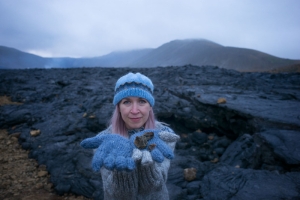
Toni Carr, aka Joan of Dark, modeling gloves you can knit with instructions from this book
We were at an after-bout party. This instigator from Indiana – Joan of Dark was her roller derby name – was running around this party carousing, convincing people to jump on a trampoline, breaking things and being like the Tasmanian devil.
dE: Sounds very Indiana/Michigan to me. That’s where I’m from.
KC: My friend said, “Oh, you should hang out with Joan. She’s doing a book of knitting.” She’d done one book called Knock Down Knits, which was a roller derby-themed knitting book. She was doing another one called Geek Knits, which was geeky knitting projects modeled by geek celebrities.
I asked, “Oh, who’s photographing that?” And she’s like, “I don’t know…you.” So I spent a lot of time going around to Star Trek conventions; I met the bots from MST3K. I stayed at George R.R. Martin’s house for a week trying to get him to pose for one photo.
dE: I heard you tell that story. You didn’t explain why you were there, but the story of trying to get a picture of him. You ate at a lot of buffets, right?
KC: Yeah, I did. We had a great time doing the book. Maybe two years later I was in Iceland working on a documentary about cryptocurrency mining and infrastructure. While we were there, I saw all these people walking past in these sweaters, and they weren’t like sweaters I’d seen before. So I’m taking pictures and I’m texting them to Joan…
“Do you know anything about these sweaters?”
Joan said, “I’ve never seen those before.”
dE: Oh, wow. So you brought the Lopapeyasa to her?
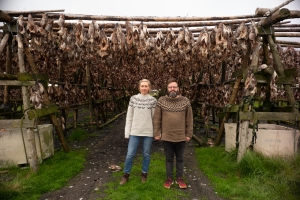
drummer Kiddi with his girlfriend; yes, those are fish heads.
KC: I did. She wasn’t finding any books about this in English. I told her, “This seems really cool. Iceland’s amazing. You should come to Iceland.” I took a couple pictures, met a whole bunch of people and made all these contacts. One of them was this musician named Kiddi. He’s in the book. Kiddi’s a session drummer who’s been on every record recorded in Iceland. Everybody in Iceland knows everybody in Iceland anyway: most of the people live in one city and everybody’s related.
Joan and I came maybe three months later, and we just stayed for four days. We did this sort of bombing run; we saw all these friends of Kiddi’s and just took pictures and wrote up a little travel diary. Then we sent it to my agent as a proposal and he sold it pretty quickly. We went back to drive the Ring Road, this road that goes all around Iceland. Iceland was so unique and unusual to me. It’s like no place that I’d ever been. And so I wanted part of this book to be travel diary.
I think a lot times one partner interested in knitting and the other one is not. It’s rare that you find a couple, like, “We’re going to knit socks together.” I wanted to construct a book for knitters and the people who love them.
dE: …which is exactly why I thought this is a really great idea.
KC: It turned out that there’s a mystery story, too: a fiber arts mystery in that people generally don’t know how the lopapeysa came to be. One of the knitwear designers that we talked to said she would go to her kids’ school play set in the 1300s or something like that, and everybody’s wearing a lopapeysa and living in a mud house. She says, “No, they didn’t have them back then.” So then it became a question of whether we could also unravel this mystery and find how the first lopapeysa was made.
There are three things going at once. There’s a knitting book, there’s a fiber arts mystery, and then there’s travel. Those are the three layers of this book.
dE: I said this book is like everything people hate about cooking blogs, but done right. It’s set up with an instructional aspect. In “Getting Started” you lay out the travel guide part, with some research suggestions. But at some point you decided you were going to learn to knit – am I understanding that correctly?
KC: Yes, I did. COVID happened. We’d already sold the book. Our publisher said, “Well, we’ve announced the book and we need content to keep people interested because it’s not going to be done in the timeframe we though it was.” Somebody – probably Joan – came up with the idea that she would teach me how to knit over Zoom.
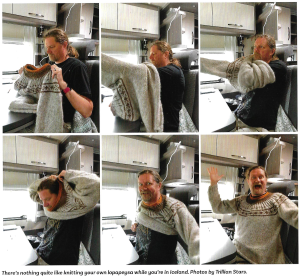
Kyle Cassidy in the sweater he was knitting
Now we’d add a fourth layer: I would knit a sweater while we were in Iceland.
dE: Can you do that? How long were you there?
KC: We were there two weeks.
dE: Is that long enough to knit a sweater?
KC: I finished, yeah. There’s pictures of it along the way.
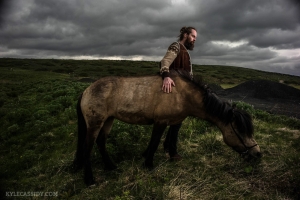
Addi with one of his horses
dE: That’s great! My favorite part was where the guy says, “We’re going to go see the waterfall. It’s behind this famous guy’s house. There will be horses.” At the beginning, though, you explain how there are very specific means of transportation for different things you need to do in Iceland.
KC: Horses are everywhere. We got to ride horses eventually. One of the things I wanted to do while we were there is find this Icelandic heavy metal band called Sólstafir. “Sólstafir” means “fingers of God” – like after a storm when there’s a break in the clouds and rays of light come through like fingers. They wore lopapeysa sweaters in their heavy metal videos. I’d been messaging their record company for probably six months and getting ignored. I mentioned this to Kiddi the session drummer; he says, “Oh yeah, I know those guys. I’ll call them for you.” And they called me right back. The singer, Addi, owns horses, so we went to his horse farm.
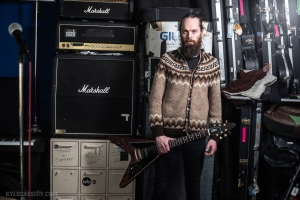
guitarist Addi of Sólstafir
And that’s his Icelandic sweater that his grandmother knit him.
dE: Somebody told you everybody has three sweaters: one their mother knitted them, one their grandmother knitted them, and one that somebody left at their house after a party.
KC: Yes. I asked everybody while we were there if that was true, and they all said, “Yeah, that’s fair.”
dE: Nice. I feel like there’s not enough sweater tradition, at least amongst the people I know in America, but I have quilts. I’ve got the quilt my grandma made and the one her mother made and one that my mom made, and suddenly I realized that there’s this thing I’m going to need to do at some point.
KC: The quilt’s probably a good example because it’s something that you can do with other people. It’s something that’s often intergenerational. It’s something that you can take with you, and it’s also something that’s practical.
dE: Functionality seems to be really important within the Folk arts.
KC: It’s absolutely functional. And all these, they were knitted for the people going out fishing, and it was cold out there.
dE: Being from Michigan, I understand cold fishing.
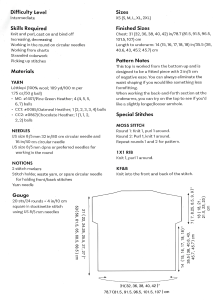
example of a knitting recipe from the book
KC: And what I found interesting too is this is a sweater pattern from the 1970s. And people knew the name of it. They’re like, “That’s the Dalur sweater, made in the 70s. My grandmother had that pattern around her house.” We met a lot of the OG women who invented these sweater designs in the 1950s, and they were all in their late 80s or 90s. And one of them, Palla, who’s in the book, died just before the book came out, but her family sent me her knitting needles.
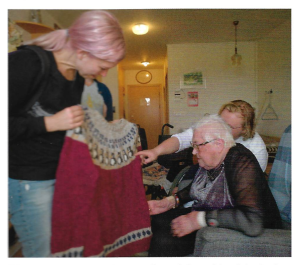
Palla tells Joan, “You have a great understsanding of the spirit of the lopi” – the O.G. seal of approval.
dE: It’s nice that the culture supports the tradition. Did you determine some kind of a timeline for the origin of the Lopapeysa?
KC: Yes. I think we solved this mystery.
dE: Oh, cool. Don’t tell me.
KC: No, I won’t. If people read the book, I hope they read the narratives too, and don’t just go straight for the patterns.
dE: I think they have to. The prose is really accessible and it’s not dry…not like a cooking blog at all.
KC: I haven’t looked at this book in a long time. It’s pretty good. Volcanoes, heavy metal bands…
dE: Sweaters. I mean, it’s got anything you could want. Horses.
KC: Caves.
dE: And waterfalls, right?
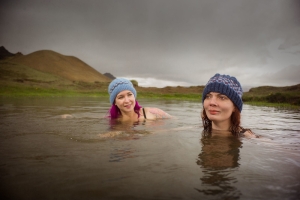
soaking at the artificial beach
KC: Yeah. Extreme weather. Oh my gosh…(Kyle holds up a picture.) So all of the sand in Iceland is black because the island’s volcanic. So this is a beach where they shipped in tons and tons of white sand from somewhere else so they could pretend they were in someplace that wasn’t Iceland.
dE: For the tourists, yeah.
KC: No, for the Icelanders. The tourists all want to go to a black beach. You can’t swim in the water in Iceland because it’s freezing. So in this particular place, they put up a wall. It’s like a giant pool that simulates a beach, so you can pretend you’re in Spain or France. And they all just hang out there and talk.
dE: I like it better if it’s for the Icelanders.
KC: (flipping pages) Yeah, this is a pretty good book.
dE: It is a pretty good book. I’m excited to write about it.
Folks, it’s a really good book. The Lopapeysa Sweater would make an excellent gift for your knitter, your world traveler, for the people who love them. You can find it at your favorite book-buying place. I got mine online at Simon and Schuster. Solve origin mystery of the Lopapeysa sweater and learn the utter horror of how cardigans are made – you won’t believe it.
 debora Ewing writes, paints, and screams at the stars because the world is still screwed up. She improves what she can with music collaboration, peer-review at Consilience Poetry Journal (based in the UK), or designing books for Igneus Press. deb is on the editorial board for Berlin-based Beyond Words Literary Magazine. Follow @DebsValidation on X and Instagram. Read her self-distractions at FolkWorks.org and JerryJazzMusician.com.
The Lopapeysa Sweater: a Book, an Adventure, a Guy and Some Needles
NUMBER 53 - How a Photographer toured Iceland and knit his own sweater by way of roller derby
November 2026