
The Gentle Protest – Jean Ritchie’s “Black Waters”
Number 82, April 1, 2026
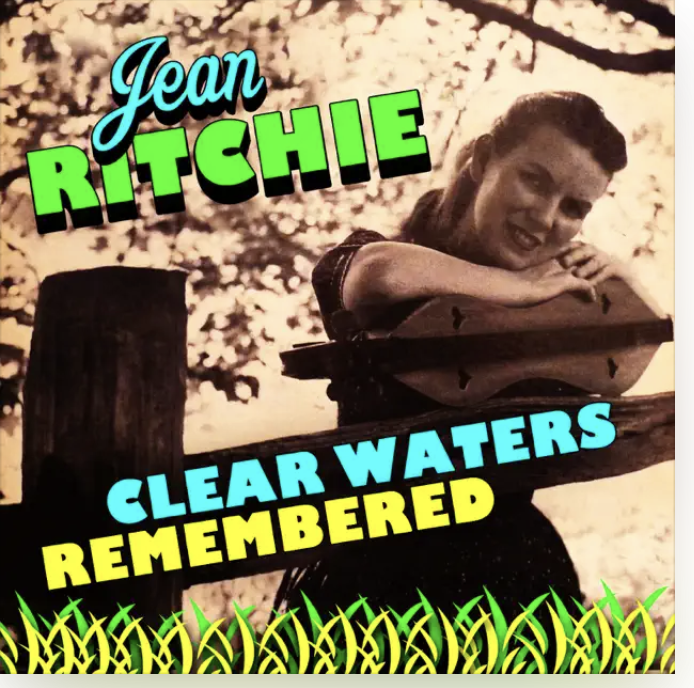
 One of the gentlest protest songs that has ever been composed is the song “Black Waters,” written in 1971 by one of the gentlest people I ever knew, Jean Ritchie. Though I refer to it here as a “protest” song, it’s clearly written with a sense of relaying facts of a situation that can rightly be referred to as tragic – sincerely in the hopes of spurring activism. Though Jean never set out to be an activist, I believe that when she was exposed to this kind of writing through her associations with Pete Seeger, Woody Guthrie and others during the folk revival movement of the 1960s, she was inspired to make commentary about what she saw around her in her ancestral home of Eastern Kentucky.
“Black Waters” tells the story in grim detail of how the coal industry’s use of strip mining completely destroyed the landscape in Eastern Kentucky, along with the farms, homesteads, livelihoods and economy of the region. Even history seems to be erased in the saddest passage of the song in which the grave of a precious family member has been buried so far beneath the towering silt it will never be seen again.
This continues through today as the Trump administration’s proposed to slash Appalachian Regional Commission funding by 93% — from over $200 million to just $14 million — threatening to dismantle one of the last federal bridges to the region. Reference
Commentary by Kate MacLeod on “Black Waters:”
…[I]t’s an excellent example of a folk song, story song, and an environmental activist song. Jean spoke in interviews and documentaries about her reluctance, when young, to be known as an activist, primarily because of her cultural background in which it might have been frowned upon by some in her family and regional culture. But like so many of her songs, it’s clearly a statement, practically unbridled. The song’s lyrics are from the standpoint of someone who’s seen the destruction of their land. It also has the extra edge of stating how people can be misled or taken advantage of by a large company. The song doesn’t state that she didn’t support mining in general, but is a statement that the use of “strip mining” is destructive and polluting….Each one of the lyric lines is a truth in itself, written with simplicity and clarity in much the same way John Steinbeck or Woody Guthrie would have written.
Along with “Black Waters,” Jean would go on to write additional songs about the Kentucky coal industry culture and its laying waste to lives and livelihoods. “Blue Diamonds Mines,” “West Virginia Mine Disaster” and “The L&N Don’t Stop Here Anymore” told stories of further degradation and tragedies in her community. Those songs will be illuminated in next month’s blogpost.
For now: here is my dear Jean singing her song “Black Waters” in 1986. In her simple, graceful singing style, the power of the gentle protest is evident. Full lyrics are below the video.
Black Waters
By Jean Ritchie
Copyright Jean Ritchie, Geordie Music, 1971
I come from the mountains, Kentucky’s my home
Where the wild deer and black bear so lately did roam
By the cool rushing waterfall the wildflowers dream
And through every green valley, there runs a clear stream
Now there’s scenes of destruction on every hand
And only black waters run down through my land
Sad scenes of destruction on every hand
Black waters, black waters, run down through my land
Well, the quail, she’s a pretty bird and she sings a sweet tongue
In the roots of tall timber she nests with her young
The the hillside explodes with the dynamites roar
And the voice of the small bird is heard there no more
And the mountain comes a sliding so awful and grand
And the flooding black waters rise over my land
Sad scenes of destruction on every hand
Black waters, black waters, run down through my land
In the coming of springtime we planted our corn
In the ending of springtime we buried our son
In the summer come a nice man saying everything’s fine
My employer just requires a way to his mine
Then they tore down my mountain and covered my corn
Now the grave on the hillside ‘s a mile deeper down
And the man stands a talking with his hat in his hand
While the poison black waters rise over my land
Sad scenes of destruction on every hand
Black waters, black waters run down through my land
Well I ain’t got no money, not much of a home
I own my own land, but my land’s not my own
But, if I had ten million, somewheres thereabout
Well, I’d buy Perry county and throw them all out
And just sit down on the banks with my bait and my can
And watch the clear waters run down through my land
Well, wouldn’t that be just like the old promised land?
Black waters, black waters no more in my land
Black waters, black waters no more in my land.
As always, thanks for reading! See you next time….
Love and Blessings,
Susie

Photo by Cam Sanders
Award-winning recording artist, Broadway singer, journalist, educator and critically-acclaimed powerhouse vocalist, Susie Glaze has been called “one of the most beautiful voices in bluegrass and folk music today” by Roz Larman of KPFK’s Folk Scene. LA Weekly voted her ensemble Best New Folk in their Best of LA Weekly for 2019, calling Susie “an incomparable vocalist.” “A flat out superb vocalist… Glaze delivers warm, amber-toned vocals that explore the psychic depth of a lyric with deft acuity and technical perfection.” As an educator, Susie has lectured at USC Thornton School of Music and Cal State Northridge on “Balladry to Bluegrass,” illuminating the historical path of ancient folk forms in the United Kingdom to the United States via immigration into the mountains of Appalachia. Susie has taught workshops since 2018 at California music camps RiverTunes and Vocáli Voice Camp. She is a current specialist in performance and historian on the work of American folk music icon, Jean Ritchie. Susie now offers private voice coaching online via the Zoom platform. www.susieglaze.com
The Gentle Protest – Jean Ritchie’s “Black Waters”
Number 82, April 1, 2026