
Say Their Name Say Their Name
Black Mentors to White Country and Bluegrass Stars
 Just as most people are unaware that the banjo came from Africa, most people are also unfamiliar with the role African Americans had in shaping Bluegrass and country music. I know I didn’t know until I uncovered it for myself. When I started digging deeper into roots music and doing my own research into the history of Black music in our country, it started to make sense why I’ve been so drawn to fiddle and bluegrass music- string band music. My ancestors played this music. This music is a part of my DNA. String band music has my heart, and like I’m sure many other Black people who were raised on the force-fed idea that this music is by and for white people only, I felt a bit confused by it. Even my family raised a slight brow at me and especially when I started playing this music myself.
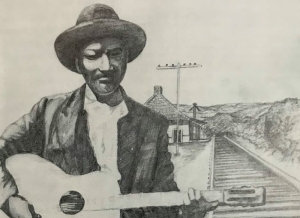
Drawing of Arnold Shultz, courtesy of IBMA
A few years back I applied for the Arnold Shultz grant from the IBMA foundation. I happened to be doing a bit of research on Black string music and on grants for Black musicians to raise funds towards my first album and boom, I learned about Arnold Shultz! Arnold Schultz was a Black fiddle and guitar player and banjo player from late 1800’s. He led dances and played guitar with an innovative thumb and finger picking style and he happened to have mentored a young Bill Monroe. Many people have heard of Bill Monroe – “the father of bluegrass music” but have never heard of Arnold Schultz. Arnold Shultz took the young Bill Monroe under his wing and showed Bill his guitar playing and finger picking style. Bill was actually even given his first musical gig playing with Arnold Schultz. It is said that the Travis picking style Bill Monroe made famous was largely influenced by Arnold Schultz and many call Arnold Shultz the godfather of Bluegrass because if Bill Monroe is the father then naturally Arnold Shultz is the godfather.
Now this kind of mentorship was quite common, and if you think about it it makes perfect sense. I’d say we have the record companies to thank for our miseducation, but let’s come back to that.
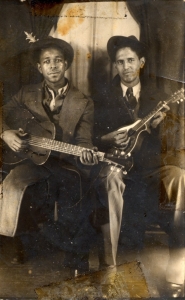
Brownie McGhee and Lesley Riddle, courtesy of birthplaceofcountrymusic.org
See, the banjo came from Africa but other string instruments like the guitar and fiddle were also played by African Americans but not as recorded and certainly not marketed. The music that Black people played, the spirituals, the call and response, ring shout tunes, and the music they would play either for their own entertainment or also as a means of communication through slavery and during the underground railroad made its way into shaping the American music we know and love today.
Many Black people were either required or hired to play for white audiences. Many Black musicians also took on teaching white people and their family members for various reasons. Think about The Carter Family. Lesley Riddle, a black guitar player, helped A.P. Carter of the Carter Family shape his mountain songs and greatly influenced the fingerpicking guitar style of Maybelle Carter. (Here’s Rissi Palmer on Lesley Riddle.)
Country music wouldn’t be what it is today without Rufus “Tee Tot” Payne who took little eight-year-old Hank Williams under his wing and taught him everything he knows on guitar. Or without Gus Cannon and his influence. The young appliance salesman by the name of Johnny Cash would sit down with Gus Cannon day after day to learn his tunes.
Black history is American history. Black string bands have been around since the start of it all but because of their limited recordings and the racism in the music industry, we the people lost out on much of this music and culture. This is where the record companies come in.
The record companies were dead set on marketing and segregating the music recording what they called hillbilly music for white people and race records for Blacks. They were not looking to represent Black people playing string music. Why? Because, well, record companies decided the money was in marketing certain music styles based on race and Black people played the blues. This is where we get the term race records and hillbilly records.
It’s much harder to know Black stringbands existed if they weren’t being recorded. Black musicians would often play on these “hillbilly records” but their names and their images were stripped for racist marketing purposes. This is our country. This is our American history.
We’re not talking about the people who stole Black music and made it their own. That’s not really the trail that I’m trying to ride today. Specifically, I want us to take a closer look and talk about mentorship. Black musicians, Black string musicians who took white musicians under their wing and shared what they knew. These musicians passed the music onto their mentees just as they would in their own Black families and this is what laid our foundation for bluegrass, folk, country, and Americana music we have today. These musicians have largely gone unrecognized and I think it’s important that we say their name. Lets get to know as much as we can about these people and do our own further research. This is just the tip of the iceberg here and I encourage you to go deeper and learn more.
So Bill Monroe had Arnold Shultz. Hank Williams had Rufus “Tee Tot” Payne, Carter Family had Leslie Riddle, a young Johnny Cash had Gus Cannon.
Have you heard of any of these Black musicians? My guess is for most of us, probably not and it’s not necessarily our fault but together we can do better. We can learn our collective history and be open to learning the truth, and, we can say their names! Arnold Shultz, Gus Cannon, Rufus Tee Tot Pain, Leslie Riddle and so many others deserve recognition. Remember, Black history is American history. Happy Black history month!
~Azere
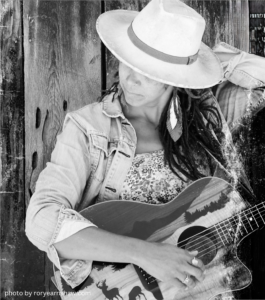 Azere Wilson unravels tangled herstory to find her identity as a mixed race Black American woman experiencing racism in our country as did her ancestors. Growing up without her Black family, music helped her find her voice and use it. She shows herself coming out the other side raw, vulnerable, inspired, beautifully connected to her lineage.
Say Their Name Say Their Name
Black Mentors to White Country and Bluegrass Stars