

Remembering Dudley Laufman
Caller, Dance organizer, Musician, Poet, Story teller, Author, Gardener, for nearly 80 years!
In Memoriam, Dudley Laufman, February 7, 1931 – July 13, 2026
Dudley Laufman, longtime supporter of Maine Fiddle Camp and famous contra and square dance musician and caller for over 7 decades, left this earth today in the home in Canterbury, NH that he built in 1959. He was 95. He had been in Hospice Care at home for a couple of months, and called and played for his last dance – a party at his home – on May 3rd. His five children were with him a great deal these past couple of months.
Dudley
I got to know Dudley Laufman quite well when we were both on staff at Maine Fiddle Camp.
After Dudley passed, I wrote this piece for the Fiddle Camp newsletter. We’re about to start our August Camp sessions without Dudley. It will not be the same.
Dudley was an “institution” at MFC, having attended pretty much EVERY Camp session to teach the old tunes to the orchestra and call an old time country Barn Dance. Dudley called and played for dances for nearly eight decades, his last dance being done at home on May third of this year! When we were at Camp last month, we knew that Dud was in hospice care, so a good amount of time was spent honoring Dudley, including calling some of his dances and playing some of the tunes he had composed. I’d like to start off here with camp director, Doug Protsik’s tribute to Dudley from the MFC stage this June.
Here it is:
Doug talks about how everything started (for him at least) at Bowdoin College and also how the dance “Black Joak” kind of hooked him into this music and dance that has become the mainstay of Maine Fiddle Camp for the past 30+ years. Well, not surprisingly we don’t have any recordings of that dance in Bowdoin, what? 45 years ago? BUT just recently Dudley was back at Bowdoin and guess what? Yeah, they played and we danced “Black Joak!!”
Here’s the video clip:
BOWDOIN COLLEGE STUDENTS DANCING BLACK JOAK 45 YEARS LATER – What goes around comes around, right?! Wow!
Here’s a video of the dance Black Joak danced in Tamworth, NH in May of 2024 with a little more explanation from Dudley about the dance:
It’s pretty evident from this video that Dudley wasn’t prone to “overteaching”. He was always one to teach the minimum and “let the dancers work it out for themselves”. Here’s another example of that with Dud teaching and calling the singing square, “Marching Through Georgia.” This was in the living room of his home in Canterbury, NH (same place mentioned above in the short obit).
Dudley Laufman – Marching Through Georgia – singing square
There’s a TON of stuff written about Dudley which you can find online. Videos, interviews, many awards, take a look, but plan to spend some time there! Click this link for the great video by David Millstone:
Dudley was a musician, a caller, a “dance leader,” a poet, a dancer, an author, a gardener, and quite a story teller. I’m going to try to retell a couple of his stories here then tell a few of my own.
1965 Newport Folk Festival
Dudley loved to tell this story. I’ll start part way in, otherwise it gets too long! In late 1964 or early 1965, Dudley and members of what would eventually become the “Canterbury Country Dance Orchestra,” had entered a fiddle contest at Goddard College in Plainfield, VT. In the evening they did an old time country dance for all that were there. It just so happened that Ralph Rinzler (renowned folklorist and ethnomusicologist who “discovered” Bill Monroe, Doc Watson, Hazel Dickens and many other artists who went on to become famous) was in attendance at the dance. As a co-founder of the Smithsonian Folklife Festival, Ralph had a lot of sway with the Newport Folk Festival and, long story short, got Dudley and the gang a slot at the festival on July 25, 1965. This was the same day Bob Dylan “went electric” and created such a stir on the folk scene. So back in that day the big contra dance revival hadn’t quite happened yet, so Dudley and the group of musicians and dancers were scheduled to do a “dance performance,” sort of a demonstration and the venue was right adjacent to where Dylan was playing on the main stage. Apparently this “demo” quickly devolved into a barn dance for all and was still going strong when Dylan’s concert was over (Dylan’s concert was quite short that year). As the audience left (most were stunned), they went right by Dudley’s dance, saw what was going on, said “well this looks like fun,” joined in, quickly forgot about the concert and got sucked right into the dance!
Black Joak
Back to “Black Joak,” which, while Dudley didn’t write the dance or the tune (the tune is an old one from England or Scottish that dates back to the early 1700s), it is very much associated with Dudley This is the dance where, at the end of each musical phrase, all the dancers sing “hi ho diddley-dum.” (This phrase was part of a bawdy English street song back in the 1800s that sort of made its way into the dance!) Anyway, Dudley recounts a dance in New Hampshire for 300 high school kids who really got into the diddley dum part and the hand clapping part so much that they insisted he call the dance again and again. (They danced it 4 times!)
My Remembrances of Dudley
Back when I started contra dancing, say the early ’70s, I was aware of Dudley Laufman. He was up in New Hampshire and called these dances called “Dudley Dances.” At the time I was totally hooked by the new “modern urban contra dance scene.” There were bands like Swallowtail who toured around and our local dances (this was in Philadelphia) were starting to hire bands and callers “from away,” and soon I found myself traveling to NEFFA (New England Folk Fest) to dance, and shortly thereafter the Brattleboro Dawn Dance to dance all night. What fun, yet when I first started we were dancing a lot of the old “chestnuts” like Hull’s Victory, and Lady Walpole’s Reel, even Money Musk, dances I am quite sure Dudley was also calling at that time. So his name did come up. When I moved to Maine in the early ’80s, I attended my first “Dudley Dance.” Dudley was different than the callers I was familiar with. He was very straight spoken, well, more than that, let’s say he never “babied” the dancers, and while being “politically correct” wasn’t as big a thing back then as it is now, he never held back speaking what he thought. “I’m a musician not a magician,” he would say when dancers didn’t do what the dance needed them to do.
Moving forward to Maine Fiddle Camp (MFC), early 2000s. I wasn’t at MFC at the start, but when I did join the staff, Dudley was already a regular part of the program. He’d show up for one day of every camp session and do a dance orchestra workshop and then play and call the evening barn dance. Dudley and I quickly became friendly and would chat about the old dances and choreography. I would most often play in the orchestra when he was calling and while watching him “work the crowd,” I realized I had a lot more in common with him than I had originally thought. At the same time, in my own calling career, I was moving more away from the complicated modern “everyone moving all the time” complex modern contras and gravitating to the “whole set” old time barn dances, which, of course, fit right in with what we were doing at Fiddle Camp, and, of course, much of what Dud had been doing all the time. After I finished calling one evening dance, Dudley came up to me and offered “hey, I really like how you call a dance.” I was a little flabbergasted at the time and all I could say back was, “I like how you call a dance too,” which was true, of course. Some time after I remember thinking “Oh my gosh, I’ve become Dudley!” Well no one could ever be like Dudley, but I was proud of what he said.
One final thing I want to say is that, while many of the “older” callers resisted the change to “gender neutral” role descriptions like Larks and Robins, or whatever, Dudley definitely did not. It wasn’t only because the dances he was calling were inherently free of gender roles. You danced with your partner or your neighbor (Dudley would say “opposite”), and mostly, he’d just let the dancers figure it out for themselves, (which they almost always did!) He also understood “why” we wanted to move away from gender roles. I guess he understood that anything that got more folks dancing was the right thing to do.
Lady of the Lake
The contra dance “Lady of the Lake” is often thought of as “The Maine State Contra Dance.” Dudley thought MFC should have his own version of Lady of the Lake and we spent some time batting this around. Here are Dud’s own words about the dance:
“I have never used any music that goes by the name of Lady of the Lake. I like to use Climbing The Golden Stairs, tossing a bit of Marching Thru Georgia in there. I do like a jig for that dance, but reels are ok too. Ralph Page recorded it to Climbing the Golden Stairs. But I also heard him do it to Irish Washerwoman. Haymakers Jig is what I do because the down the middle four in line sort of does away with the tricky cast off. I often wonder where the dance actually came from. It is old enough to have been around when duple proper dances were what was being done. I wonder if it was originally a proper dance?
Active couples cross over and swing the one below
Actives swing in the middle
Down the center (4 in line)
Cast off on the proper side…Rights and lefts. ????
One time at the Ralph Page Legacy Weekend, I was MC for the Sunday afternoon farewell party. Most of the dancers were accomplished, a good mixture of young folks in their 20s and 30s, and then some old timers who had danced to Page back in the day. None of them knew anything about callers playing fiddle and calling at the same time. Old Grey Goose was one of the featured bands, so i arranged for them to play/call Lady of the Lake. They got Bob McQuillen on the piano . They used Rolling off a Log. No microphones. Carter started it off yelling at the top of his lungs. OK, get yer partners for Lady of the Lake. First, third, fifth couples start the dance (no hands four) Balance and swing below.
Balance and swing yer partner in the center, shouted Doug. Down the center, bellowed The Smoke (Smokey McKeen). Ladies chain, they all hollered together. The dancers didn’t know what was going on. I ended up being in bad odor with the committee. They said I was a loose cannon, and I didn’t get asked back for three years. But I must say they hired the Canterbury Orchestra three times, and I was the subject of the retrospective.
cheers, Dudley”
(He goes on)
“I have no idea when or where LOL was actually brought to life. No mention of that in any of the books I have. I do know that it was/is done in Maine more than other places along with its relatives Haymakers Jig, Boston Fancy (Lady Walpole’s Reel), Green Mountain Volunteers (Mountain Ranger) Swing Your Jenny (Page or Sammy Spring?) It has to have come from somewhere. Overlock did it way back in the day (1920s, so it certainly was around then. Good subject for someone to get their teeth onto.
cheers, Dudley. Still sugaring over here.“
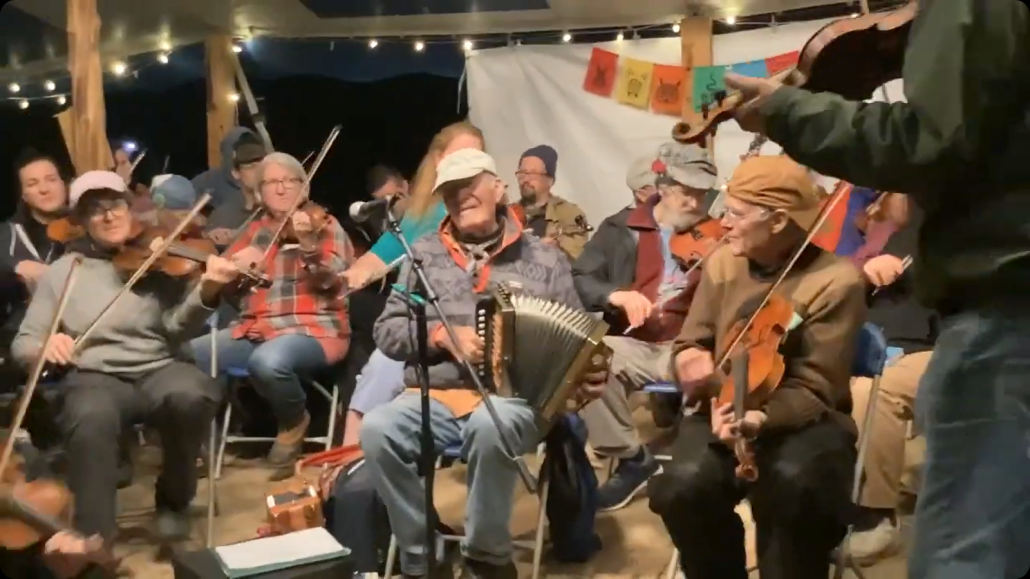
DUDLEY CALLING AND PLAYING WITH MFC ORCHESTRA AUGUST 2025
MFC LOL
So here is MFC Lady of the Lake – Music: Rolling Off A Log
A genderfree set dance. Longways for as many as will. Of course, everyone will. No progression although there might be.
A1 Swing person on either side of you. If you end up standing alone, just jig in place
A2 All swing partner
B1 All chasse down middle and back to place
B2 Turn partner with one hand, then with the other
Dudley Laufman
TUNE HISTORIES
Here are a couple tunes we ALWAYS played at Maine Fiddle Camp when Dudley was calling. The first is “Mistwold.” a reel composed by Dudley, normally played in the key of G, AABB, standard tuning on fiddle. The tune was written in honor of Mistwold Farm in Fremont, New Hampshire, where he first country danced. Dudley said: “Jonathan Quimby was my first fiddler and Mrs. Sheldon the pianist. We danced in the living room on the orange wide-boarded floor. Everyone could tell when we had come straight from the barn without bathing because of the heavy odor of talc”. The second tune is “Patty’s Orange Cape,” another reel (or march) also composed by Dudley, normally played in the key of G, AABB, standard tuning on fiddle.
Here are recordings off Dudley’s CD with the Canterbury Country Dance Orchestra “Here’s to Every Country Dance.” Hearing these tunes immediately makes me think about a Dudley Dance! (Thanks to Frank Ferrel for pointing me to these)
Remembering Dudley Laufman
Caller, Dance organizer, Musician, Poet, Story teller, Author, Gardener, for nearly 80 years!