
Reggie Garrett: The Road Taken
Protest Music ~ Who gets to define it?
 The first time I met Reggie Garrett was at the 2023 FAR-West annual music conference. He was hard to miss as one of only 5 Black people at the entire Folk conference of hundreds. This is not why I was drawn to him though. He moved through the crowd with an enigmatic presence of a brilliant musician, someone I couldn’t wait to hear play and had hoped to get a chance to speak with. I had a feeling I would be able to learn so much from this man. I wasn’t wrong.
Reggie Garrett is an artist. He wasn’t raised in a house of musicians but music was always in the house. His grandmother sang gospel and all the kids sang in the children’s choir and listened to records. Attention was a hot commodity in his household with eight kids and on a good night, if you were the only one awake, you could sneak downstairs and steal a moment with his dad listening to records.
Reggie started playing guitar in high school and had a short-lived band. At one point in college he said “I opened my mouth and this high voice came out… I think I’m channeling my grandmother”. He was a baritone until then. His wife encouraged him to pursue his music career suggesting that even though he is a painter he should “push more as a musician. It seems like it’s worth it.” People were drawn to him when he played at open mics and wanted to be a part of what he was bringing and they still do. He has been writing music and making music for decades and he says when it comes to making music, there is an element of love but “we do this because we have to. You just kind of have to”.
He and his music partner Christine Gunn were one of the Official Showcase performances and I couldn’t wait to hear whatever magic they would bring. I knew I was gonna love what came from this man but I had no idea I would be this blown away. I couldn’t believe his voice, the storytelling, the depth, the brilliance, the otherworldly nature moving from the ethers through him and resonating out to the rest of us. WOW!
As you can imagine, I was thrilled to see him in the audience at one of my private showcases—after which we got a chance to spend a lil time and he showed me a thing or two about fingerstyle guitar. I felt like I was stealing a moment getting a chance to sit with a legend.
Fast forward a couple years later, we are again thrust back to a time when we seek out the Folkies and the protest tunes, wanting to hear collective anger and feel moved by music speaking truth. As a society, we have an idea of what a protest musician looks like and of course Pete Seeger and Bob Dylan, and the like are first to come to mind for most people. But what truly defines a protest musician or protest music in the first place?
I am curious why Black musicians and Black music are not what people see first as protest music, even though our existence is protest-embodied. Sam Cooke, Nina Simone, and mayyybeeee Champion Jack Dupree probably top the list for protest songs from Black musicians. Less likely are Big Bill Broonzy with his tune Black Brown and White Blues; LeadBelly with Bourgeois Blues, or Bessie Smith with Poor Man’ s Blues and Woman’s trouble blues, even though they are some of the earliest protest tunes speaking truth to inequality—and not only for Black people.
Reggie Garrett himself is a walking, living, breathing protest. His very existence calls to action—change. His music is an intellectual social movement. His lyrics speak volumes of truth. His voice pulls us in and forces us to listen close and pay attention. His music asks us to rethink not only what music protests but how music protests. Reggie bends genres and makes us take a deeper look inside and out, questioning expectation, reason, and our own ideals.
I got a chance to interview Reggie a couple months back. I learned how the truth his music speaks flows in any genre. Listening to Reggie’s earlier music with his band, The Snake oil Peddlers, versus his newest album The Road Taken, with Christine Gunn on cello, we hear how Reggie defies genre expectation, calling to my mind the big record companies of days gone by—they are not gone, they morphed—who defined genres and left us to resist, and listen, and evolve, regardless of their strong hold. The big record business put people into categories and decided for us—the listeners—what we should listen to and what we—the music makers—should be playing. It started early and kept on growing and even today Black people are still up against these racial stereotypes in music. Some of us play into them. But not Reggie.
I argue he is a protest musician because of what he challenges his listeners to confront on a deeper level. Defying genre boxes and expressing truth from ancestors and society today. His knowledge of Black history—our collective history—is evident in tunes such as “York’s Lament (a Hell of a Thing).” This is a “ballad noir: the enslaved personal servant of Captain William Clark was a peer and equal during the Lewis & Clark Expedition. At the end of the journey, though, he’s put back in his place as a slave” creating a musical canvas bringing past to present.

Stacey Abrams, photo by Flo Ngala for Rolling Stone
“Ballade de Stace A” is a “rappish allegory with a sparse but finger-snapping bass line, portraying the rise of modern-day political role model Stacey Abrams in a metaphorical card game. Off the same album, York’s Lament, his tune “Street Scenes (Down on the Corner” is the monologue of a bus driver as he goes his route, observing people in their lives and struggles. Reggie’s lyrics imbue this character with the deep knowledge of a man who’s seen everything: “Let Ignorance be our apartheid”. He sees children as hope for the future:
“There’s always room for one more on this bus / hey youngblood, don’t sweat the fools
grab your books, yeah/and climb on board.”
This song, like a bus route, circles back to the beginning with “young couples and their furtive fandangos.”
The song “The Road Ahead” off his new album with Christine Gunn, The Road Taken, is a beautiful dance between strings and vocal melody that protests against repeating the past and invites change despite the pain and despair. Their lyrics “we won’t go back again. Time to turn the page” is the powerful cry of our time. This music houses our collective anger and speaks truth to change we need to hear.
Reggie is a shape shifter, a thought provoker and just like the often-overlooked early greats, Reggie Garret is a protest musician of the most epic proportion. Just listen and you will begin to understand.
~Azere
Reggie’s newest album The Road Taken is his collab between Reggie and Christine. You can buy it here and listen here. Learn more about Reggie Garrett here and find out what’s next for Reggie Garrett and Christine Gunn here.
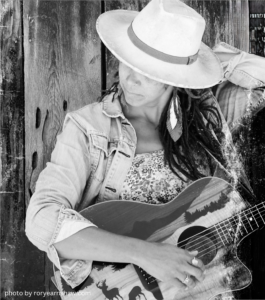 Azere Wilson unravels tangled herstory to find her identity as a mixed race Black American woman. Growing up without the Black side of her family, music helped her find her voice and use it. She shows herself coming out the other side raw, vulnerable, inspired, beautifully connected to her lineage.
Reggie Garrett: The Road Taken
Protest Music ~ Who gets to define it?