
Joe Hill – as told by Michael and Nell
NUMBER 47 - How to Research and Preserve the Workers' Legacy
May 2026
 You already know Joe Hill.
You probably know Joe hill was an immigrant. Joel Emmanuel Hägglund was born October 7, 1879. He and his brother Paul came to the United States from Sweden after the death of their mother and sale of her estate. He learned English as he went from job to itinerant job, New York to San Francisco. As an immigrant worker, frequently facing hard times, he found camaraderie and recognition among the Wobblies, as the members of the Industrial Workers of the World were called.
The thing you didn’t know you knew about Joe Hill is that he coined the phrase “pie in the sky” – it comes from his popular song “The Preacher and the Slave.” Here it is performed by Utah Phillips:
Joe Hill was a musician, a poet, an artist.
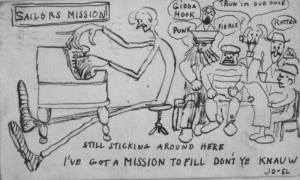
Postcard from Joe Hill at Sailors Rest Mission, San Pedro CA, to Charles Rudberg, c/o weneverforget.org
His music brought him to the forefront of the union workers’ battle, but Joe Hill also wrote poetry, drew cartoons, and painted in oils. The Labor Martyrs Project has a collection of Joe Hill’s postcard drawings sent to his childhood friend, Charles Rudberg. The postcards were acquired by the Archives of Labor and Urban Affairs at Wayne State University in 1980. Philip Mason was Director of the Archives in 1984, and does not explain how the university came into possession. You can see the postcards, and read more about them, at weneverforget.org. You’ll find a lot more about America’s labor movement.

Painting by Joe, assumed to be Joe Hill, owned by Gary Bowen
It’s worth a side-jaunt through this Salt Lake Tribune article by Sean P. Means about a painting kept safe by Gary Bowen, whose grandmother said the painting was Joe Hill’s and used to hang in the family saloon.
“I can see the relationship with Joe Hill developing, not because they were immigrants, but because there was a convenient bar downtown,” Bowen said.
“The guy was a musician, he’s a poet, he’s a cartoonist, he’s an oil-painting artist,” he said. “The man was a disciple of Christ. He was willing to be the sacrificial lamb. That’s why the legend doesn’t go away.”
Michael and Nell are Nashville songwriters. I’ve been lucky enough to hear them perform many times at the FAR-West Campfire! Songcircle – this is how I knew about their Joe Hill project. I was thrilled to ask them about it for our May 2026 issue of FolkWorks as we continue our deep-dive into Folk Protest Music.
dE: FolkWorks contributor Ross Altman wrote about The Joe Hill Roadshow when it rolled into Burbank, CA, in 2015. So how did you get involved?
Nell: A friend of ours who happens to work in the Country Music Hall of Fame –
Michael: He’s a folklorist and a bass player and a mandolin player, et cetera.
Nell: – his name is John Fabke. He found out about this Joe Hill Roadshow and asked us if we would organize a show here in Nashville. This was in 2015, which is –
Michael: That’s the centennial date of Joe Hill’s death, which was 1915. No?
Nell: Yes. There were about 40 concerts held all over the United States, celebrating the centenary of his death. We didn’t really know that much about Joe Hill, but we said yes. We had to do a lot of research and it was great. And so finally it became a presentation.
Michael: There were some steps to that, to kind of flesh it out a little bit. We learned some Joe Hill songs for this concert, and there were a number of musicians that played on it. It wasn’t just us.
And we decided, “Well, we learned all these songs. What are we going to do? ” So we started researching. We got a couple of books and read up on the life of Joe Hill and the group he was involved with, which is the Industrial Workers of the World – the Wobblies they were called back then. And we just got more and more into the information. We started to put together a presentation.
We typed it all out on pages. When we first started doing the show, we had the book in front of us, so we could read it off. Eventually we got it memorized and now we’re just talking.
Nell: I’ll show you some of the books. If anybody’s interested in –
dE: Oh yeah. (Editor’s note: Books? OF COURSE WE WANT BOOKS.)
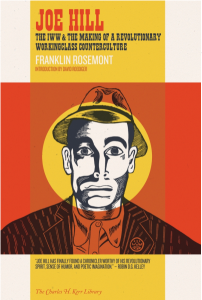
Joe Hill: The IWW, and the making of a Revolutionary Working-class Counterculture book cover
Nell: Okay. This is a book called Joe Hill: The IWW, and the making of a Revolutionary Working-class Counterculture.
One of the things that’s really incredible about the Wobblies: They had poets, they had singers, they had songwriters, they had artists, they had actors. They were really into using art as a way to organize –
Michael: There’s an example right there on the cover.
Nell: And Joe Hill himself was actually a very good visual artist as well.
dE: Oh, really? I did not know that.
Nell: Yes. There’s some of his drawings in this book. The interesting thing about him – he’s a Swedish immigrant, okay? – English wasn’t his first language. He wrote all these great songs in English.
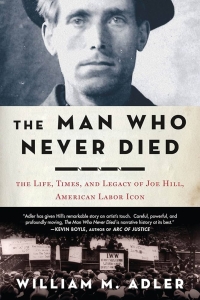
The Man Who Never Died: The Life, Times, and Legacy of Joe Hill, American Labor Icon book cover
The other book that really helped us a lot is by William Adler: The Man Who Never Died. He goes into the whole thing of –
Michael: – The Trial.
Nell: They accused him of murdering two men in a grocery store. And the whole thing was just a frame-up by the people of the powers-that-be who really hated him. Adler really did his research on what actually happened during the trial. He goes into a lot of this stuff about who he was and what happened. And pictures like of his funeral, how many people were at his funeral?
Michael: Was it 30,000?
Nell: I think it was like 30,000 people were at his funeral. And he also identifies the other suspects who probably committed this murder.
Just like today, the big wigs who had all the money hated the Wobblies because they were successfully organizing what was really the lowest rung of workers at that time. Most of the people they organized were not plumbers or engineers or anything like that. They were real guys that worked in the mines. They were really agricultural workers, stuff like that. Real grassroots people.
Michael: Yep. And one of the things that they did was they sang as a means of transferring information, and for uplifting the spirits of the workers on the line or in jail.
Nell: They always sang in jail. We have a great book from that sheriff. Is that sheriff?
Michael: Oh yeah. The sheriff of San Diego, I believe it was, he made the statement.
He said, “I cannot punish them. Listen to them singing. They’re singing all the time and yelling and hollering and telling the jailers to quit work and join the union.”
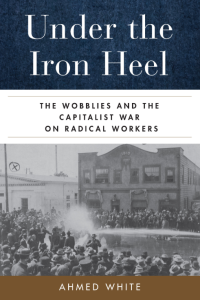
Under the Iron Heel book cover
Nell: And this is a new book that just came out a few years ago called Under the Iron Heel (by Ahmed White.) And The Iron Heel – that’s a book that Jack London wrote. If you remember him, he was a big supporter of the Wobblies. Ahmed White – he’s a professor – really did his homework. He went back and looked at all the historical records of the ways in which the Wobblies were jailed. I mean, they were sent to San Quentin. They were put in jail. They were –
Michael: Tarred and feathered.
Nell: Tarred and feathered. They were put on a train sent out of town with nothing. The persecution they endured is incredible. And so we recommend this book too, because if anybody really wants to know what war against workers is like, this tells you.
dE: Yeah, I think people should start thinking about that.
Nell: They were very militant, the Wobblies. They really were trying to build a new world, not just get their raises in pay. I mean, they really had a class consciousness about building a new kind of society. And of course, they were reviled for that.
Michael: So we read these books, made notes, and pulled information from here or there. And we managed to get it condensed enough to have a one-hour presentation. And actually, it’s actually less than a one-hour presentation because the whole thing is one hour, but half of it is song.
Nell: We put up visual stuff behind us or as an illustration as we do the thing. So we have performed the show how many times?
Michael: Forty times.
Nell: Forty times. And mostly with funding, what’s kept us able to do this is getting funding from the Tennessee Arts Commission (and others.) We’ve played the show in most of the major colleges in the state of Tennessee. One of the most exciting things that happened to us was we were invited to go to Winnipeg, Canada on the anniversary of their 100th anniversary of their general strike –
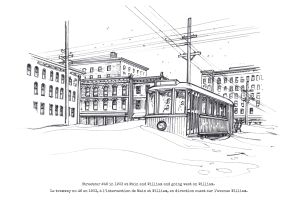
Image courtesy of 1919strike.com, where you can find interesting downloads (including a coloring book.)
Michael: 1919 General strike.
Nell: Yes. After World War I, all these sailors came back and there were no jobs. It was the largest general strike in Canadian history. On the anniversary, they brought us up to Canada to do our show.
Michael: A friend of ours was very active in the labor movement, knew a couple of the guys in that union.
Nell: Mark Brooks.
Michael: Mark Brooks got us introduced us. We sat over lunch and talked and they wound up inviting us to come up to their place. They flew us up; they put us up and treated us great. It was wonderful. And we played three shows up there, wasn’t it? Three? And one of them was at the Ukrainian Labor Temple.
Nell: That was a temple built by Ukrainian workers around that time. And it’s this incredible old building. It’s beautiful.

Interior of the Ukrainian Labour Temple NHS, courtesy of Parks Canada
Michael: One of those buildings that was destroyed at one point and rebuilt. I believe it was destroyed by the opposition because they were union, of course.
Nell: There’s estimated 35,000 workers went out on strike in 1919. With their families, they represented half of the city of Winnipeg’s residence.
Michael: They basically shut the city down.
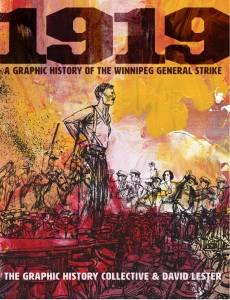
1919: A Graphic History of the Winnipeg General Strike book cover
Nell: They did. And they came from Winnipeg’s ethnically mixed working class neighborhood: Canadian, English, Scottish, Irish, Ukrainian, German, Jewish, Polish, Icelandic, and Russian workers. Some of these women and men were Canadian-born. Many others had only recently come to Canada. This book, 1919, is a history of the whole Canadian strike.
We told you that the Woody Guthrie Center was on our bucket list because every time we do our show, we always say that Joe Hill was the precursor of Woody Guthrie. And we finally got to go to –
Michael: Tulsa, Oklahoma. We went to the Woody Guthrie Center and right next to it is the Bob Dylan Center.
Nell: Right next door.
Michael: They gave us passes to go to the Bob Dylan Museum. We got to hang around the Woody Guthrie Museum – if you’ve never seen a dust storm, you can probably find an image of one on YouTube…
Michael: the Dust Bowl was like –
Nell: – a major ecological disaster.
Michael: Think about a heavy blowing snowstorm and trade it for dust. People were dying from breathing this stuff and just –
Nell: I studied two things in college: music and history. And I studied the history of movements for social change. So this is right down my alley. I was so happy that the Woody Guthrie Museum talks a lot about the dust storm as an ecological disaster, that they really give people who don’t know this stuff a background on what happened back then, because Americans are so ahistorical.
dE: Yeah. They want so badly to say, “We’re past that now,” but we’re not, are we? This is why we need to preserve the history of people living their lives. Folk music does that.
Nell: I never used to talk about this, but I actually hung out with Bob Dylan when I was in New York City.
I went there when I was quite young. We’re the same age, me and Bob. I went there with my man at that time who’s a really good singer. We pop into Greenwich Village, and who do we meet? This kid named Bob. We met him at Cafe Wha? in the Village. He was back there playing Harmonica behind –
Michael: Fred Neil.
Nell: Fred Neil. Yeah. He wrote that song, “Everybody’s Talking” – So do we want to play a song?
dE: You want to play a song?
Nell: Yeah, let’s play – what do you want to do? What we want?
Michael: Yeah, we can do that one.
“What We Want” – written by Joe Hill, performed by Michael and Nell
Joe Hill was an organizer for the working class.
It made sense that Joe Hill would tie together all that was important to him using the vocabulary that most resonated with the Wobblies: music.
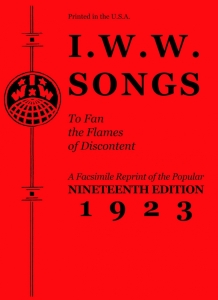
The Little Red Songbook, 19th edition book cover
The Little Red Songbook was published by the IWW “To Fan the Flames of Discontent.” It was first published in 1909 and included old songs with new lyrics – as an example, “Solidarity Forever” is sung to the tune of “John Brown’s Body.” The songbook included new songs written by revolutionary musicians like Joe Hill and T-Bone Slim. 38 editions of The Little Red Songbook were released between its inception and 2010. A call was put out for a 39th edition in 2023; its status is unknown. You can buy a copy at the IWW Store for $5.
Michael: Joe Hill, like a lot of the songwriters in his era, and even up until today, used melodies that were familiar to people so that they could automatically just pull out their little red songbook and there were the lyrics and they knew the melody.
Nell: The little red songbook was one of the things that the Wobblies were famous for. They sold thousands of copies of it for like 10 cents. So when it was time to sing, every Wobbly would pull out his songbook – he had the lyrics in front of him and he already knew the melody, so it made it really easy for people to sing along.
dE: do you have anything you want to share with people right now?
Nell: We started something here called Music for a Better World, and we’re going to SERFA, doing this and we’re asking people to come in with their songs or whatever.
One of our things is art and activism: How can we use art as activism to mobilize, entertain, and educate people about these issues? We’ve held several concerts where we ask people to come in and sing, and we’ve also done that at different Folk Alliance events.
We’re trying to embody using music and art as a vehicle for social change, especially with the history of our Joe Hill thing.
Michael: That question you sent us – you wanted to know what the message was to young people or what they could get out of it. That made me think: the one obvious thing is that learning the history that is not taught in their schools.
dE: That’s a good one.
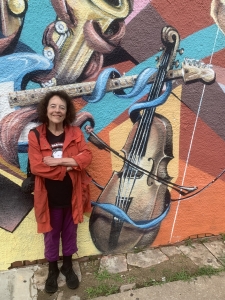
Nell, photo by Michael, Tulsa OK 2026
Michael: I never heard of Joe Hill until I listened to Utah Phillips and Joan Baez sing about Joe Hill. But the other thing that occurred to me was back then, in that time, they were doing protest activities, and so forth, and in terms of communications, they would send word out all over the country. “There’s a sit-down disruption going on in San Diego” – thousands of people would jump on freight trains and just get into town whatever way they could from all over the country. But it was kind of word of mouth, one hobo camp to the other, maybe a song. But now we’ve got all these other ways that are available for communication. Half of the stuff I don’t even know. We’ve got email for us old people and what’s that thing? Facebook and TikTok and Twitter. I’m sure there’s others that I don’t even know the names of. And the point is that they have all this available and these younger people are hip to all this technological stuff. So they could send out a revolutionary message to 10,000 people with one little click on their computer.
Nell: Well, the No Kings demonstration even here in Nashville was very well attended. So that’s an example of online organizing. But what I’m also reading about is that there’s this problem with younger people who feel alienated because they’re online all the time. They’re not next to people in the room.
dE: Yes. And that’s something that I talked about with Casey Neill, because he did a lot of Pacific Northwest environmental activism. And he said that to get out there and be in it is something different altogether. And I think the more that people are going to these protests, like No Kings and others, hopefully they feel it and understand what it’s like to connect.
It’s going to be interesting in another 10, 20 years, how this part of American history is written. And so I think it’s really important that we use our art now to record the things that maybe we shouldn’t be saying so that it is put down in history for later.
Nell: I’m an old lady and I was part of the group that protested the war in Vietnam. And back then, I was in a meeting every night with a bunch of people. And you know what? I’m still friends with those people today. Years later. We went through so much stuff together when we were in college that we’re tied together for the rest of our lives. You know what I mean? I think it was Trump or somebody who said, “Oh, all those people that are protesting are just those old hippies.” All the Old Hippies got online and said, “Yeah, that’s right. We were the ones that got rid of Nixon. We stopped the Vietnam War, and we’re coming back.”
You don’t want to mess with those old hippies. They know what they’re doing.
And Michael’s a Vietnam vet. Don’t know if you know. Well, he’s in an organization called –
Michael: Veterans for Peace. And he went to Washington DC with the Veterans for Peace to try to stop the Iraq War. They were there protesting and they went to see our Senator Bill Frist and – tell them what happened.
dE: What happened?
Michael: Just about threw us out of the office. They were the rudest people on the hill. And we went to a number of senators and reps offices and spoke with them or their people. And everybody was, as far as I remember, was pretty polite.
Nell: But not Bill Frist.
Michael: We didn’t see Bill Frist. We just saw his underlings.
Nell: These are the guys that fought these wars, damn it. These are the guys that… Michael got drafted when he was 19. Okay? “Hey kid, go.”
(editor’s note: The video starts out with images of Young Michael the soldier.)
dE: Yeah. And so when was this that you were in Washington?
Michael: 2003.
Nell: These guys went there and said, “Hey, don’t do this. It’s a stupid idea.” And of course it was a stupid idea. And what’s bad about it is that during the Iraq War, we never heard anything about who was getting killed. You know what I mean? There was no reporting back. During the Vietnam era, we saw the body bags come back on television. But with Iraq, man, there was nothing
dE: The only way we know anything that’s going on right now is because of social media and people in other countries with TikTok accounts and Twitter accounts. And you know what? One of my favorite things of this time and has been for several years now is a Facebook group, Alt National Park Service. They keep us updated.
Editor’s note: Relevant to this article, the current United States Justice Department has just moved to reinstate firing squads as a permitted method of execution. And Veterans for Peace have once again come to the U.S. Capitol in protest of war, this time Iran. Dozens were arrested.
Nell: Well, do you have any – Oh, we had another song we’re going to play, right?
Would you like us to play another song?
dE: I would love that.
“Joe Hill’s Last Will” performed by Michael and Nell
Joe Hill was accused and executed.
In 1914, a Salt Lake City grocer (also a former policeman) and his son were shot and killed. Perhaps coincidentally, Joe Hill showed up at a doctor’s office, looking to be treated for a gunshot wound, something about a woman. High controversy ensued, and a trial – Joe Hill was found guilty of the grocery store murders and sentenced to be executed on November 18th, 1915.
His last request was to not be found dead in Utah. He wrote from prison a poem which has been set to music many times, including a well-known arrangement by Ethel Raim and Joe Hickerson, and a poignant rendition by John McCutcheon.
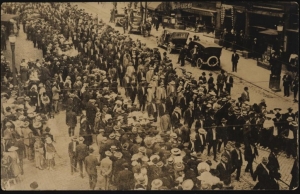
Joe Hill’s funeral procession in Chicago, courtesy of UMich Library Blogs
My Last Will – Joe Hill
My will is easy to decide,
For there is nothing to divide.
My kin don’t need to fuss and moan –
“Moss does not cling to a rolling stone.”
My body? — Oh! — If I could choose,
I would to ashes it reduce,
And let the merry breezes blow
My dust to where some flowers grow.
Perhaps some fading flower then
Would come to life and bloom again.
This is my last and final will.
Good luck to all of you.
Joe Hill
Michael and Nell want to bring their message to you.
If you’re attending SERFA in Owensboro, KY May 28-31, make it a point to find and be charmed by Michael and Nell. If your school or organization might be interested in hosting their Joe Hill Show, please reach out to them by email. All the books they discussed are available through the IWW Store as well as your usual book outlets. Learn the songs, but learn what they were singing about, too.
Don’t mourn, organize! – Joe Hill
 deb writes, paints, and screams at the stars because the world is still screwed up. She improves what she can with music collaboration, peer-review atConsilience Poetry Journal, or designing & editing books for Igneus Press. Follow @DebsValidation on X and Instagram. Read her self-distractions at FolkWorks.org and JerryJazzMusician.com.
Joe Hill – as told by Michael and Nell
NUMBER 47 - How to Research and Preserve the Workers' Legacy
May 2026