

How to Find the World in Your Community – Basketweaving with Karen Tembreull
NUMBER 51 - Next-level basketry, traditional to gallery (not underwater.)
September 2026
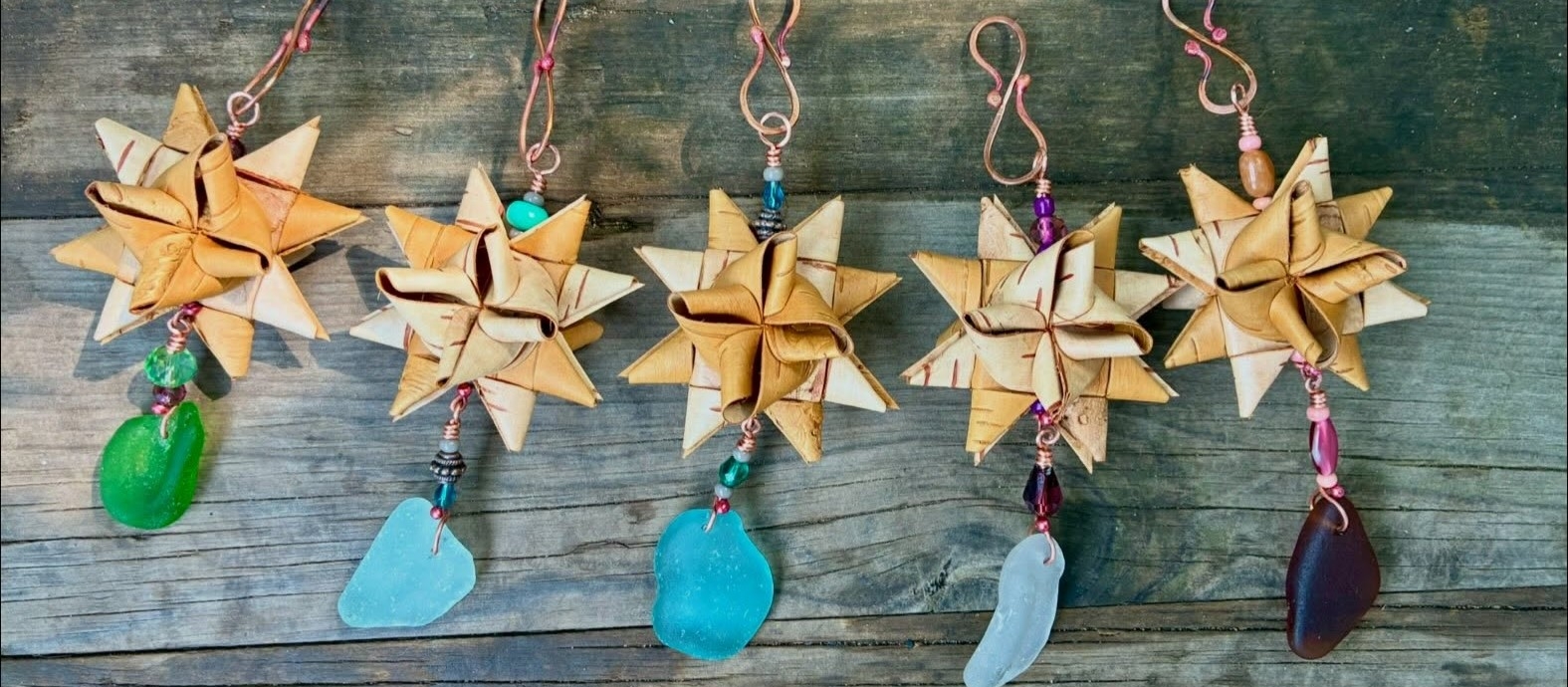 My dad used to joke about “underwater basketweaving.” This is not that. Karen Tembreull is a master of weaving with mixed media natural fibers: bark, roots, found objects. She is called to workshops, festivals, and conferences far and wide to share her knowledge with others interested in preserving Folk arts and legacy, who love doing things with their hands.
According to UNESCO, basketry is “on the representative list of the intangible cultural heritage of humanity.” Baskets are functional, but humans take the practice to artistic levels, passing techniques down through generations. Culture is preserved when people are relocated, like the Choctaw Nation who brought their swamp cane methods from Mississippi to the reservations of Oklahoma. Gullah and Geechee people, brought to the low country as slaves for their knowledge of rice-growing, still make and sell their prized sweetgrass baskets.
Karen Tembreull is going to tell us about Finnish culture imbuing Nordic functionality with their techniques.
dE: Tell me about the Finnish American Folk School.
KT: There’s a really high Finnish community here in copper country. And the reason why there’s a really high Finnish community here is the mining. And the Finns came over here also to escape Russian rule in Finland. Also, the U.P. resembles their homeland.
In Hancock (Michigan) we have wonderful artist’s opportunities: The Copper Country Community Arts Center (CCCAC) where I’ve taught, shown at and taken classes at over the years. they have a really nice Christmas sale every year, called the Poor Artists Sale. We have the Finnish American Heritage Center and its art gallery. And, the Finnish American Folk School located at the former Finlandia University campus (where my daughter went to school.)
My girlfriend Clare (Zuraw) is the director of the Finnish American Folk School. My girlfriend Phyllis Fredendall was Finlandia University’s former Fiber Instructor–the Folk School currently uses her old studio for classes, as well as the wood shop and ceramics studio. Right now this guild is booming and it’s kind of hand-in-hand with the Finnish American Folk School.
My nationality is Northern European, German, Dutch primarily. I’m not really Finnish, but there would be art shows I could present in through the Folk school.
I needed to start really teaching myself to be proficient in bias birch weaving, because when I was teaching at conventions…I have to back up a minute again. There was a lot of competition at AMB and other state conventions; people were already teaching with birch bark or elm bark, all these different mediums had already been claimed. So I started combining everything, making up my own baskets and teaching how to make mixed-media bark. I made up some of my own weaves and combinations of weaving with lace work.
To see where the Finnish tied in, because Finnish – you can’t call them Scandinavians because they’re not. They’re separate; their language ways are totally different. So Nordic is the word we’ll use. So, Nordic cultures have this birch bark weaving technique, which is my focus for teaching at the FAFS, which is a double wall technique. You weave up to and over the rim and back down to the base. Every little square of weaving has actually four layers because the two pieces cross and the outer layer not only weaves over the inside layer but is woven back into every woven space. It’s time consuming and makes it have a fabric-like feel. It’s super functional.
I had learned that kind of weaving from a weaver who co-wrote this book, Vladimir Yarish, and here he is. (Karen shows me the book, Plaited Basketry with Birch Bark.) He doesn’t come here anymore because he doesn’t have a visa. When the conventions were booming, he taught a lot and you couldn’t always get in the classes; you would sign up for the same class every year and not be able to get into it because it filled. I ended up taking a couple classes from him and learning how to do plaited weaving. Bias is different from straight plaiting. Plaiting is with flat material, like the bark.
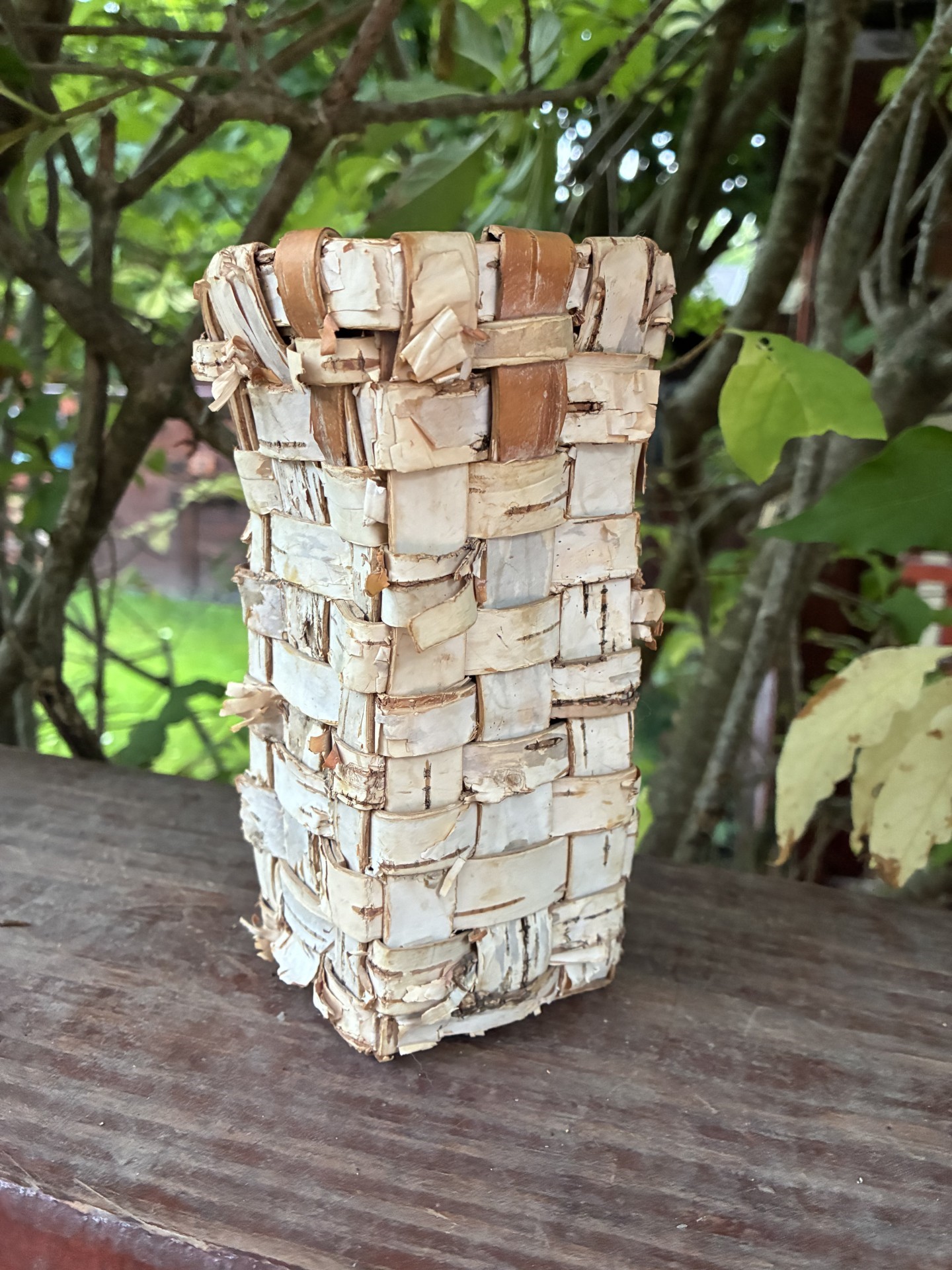
-
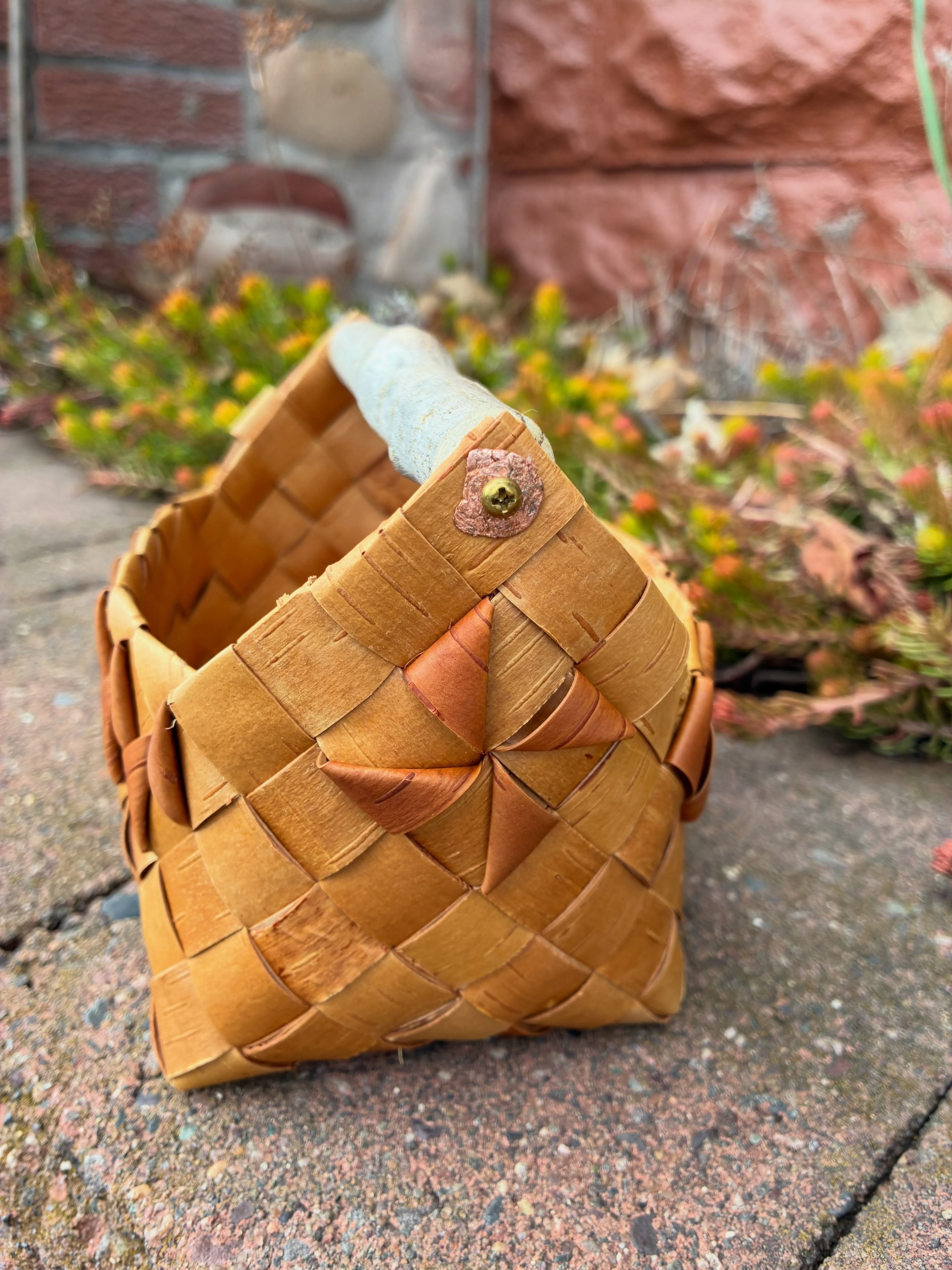
- example of bias plaited weaving
-
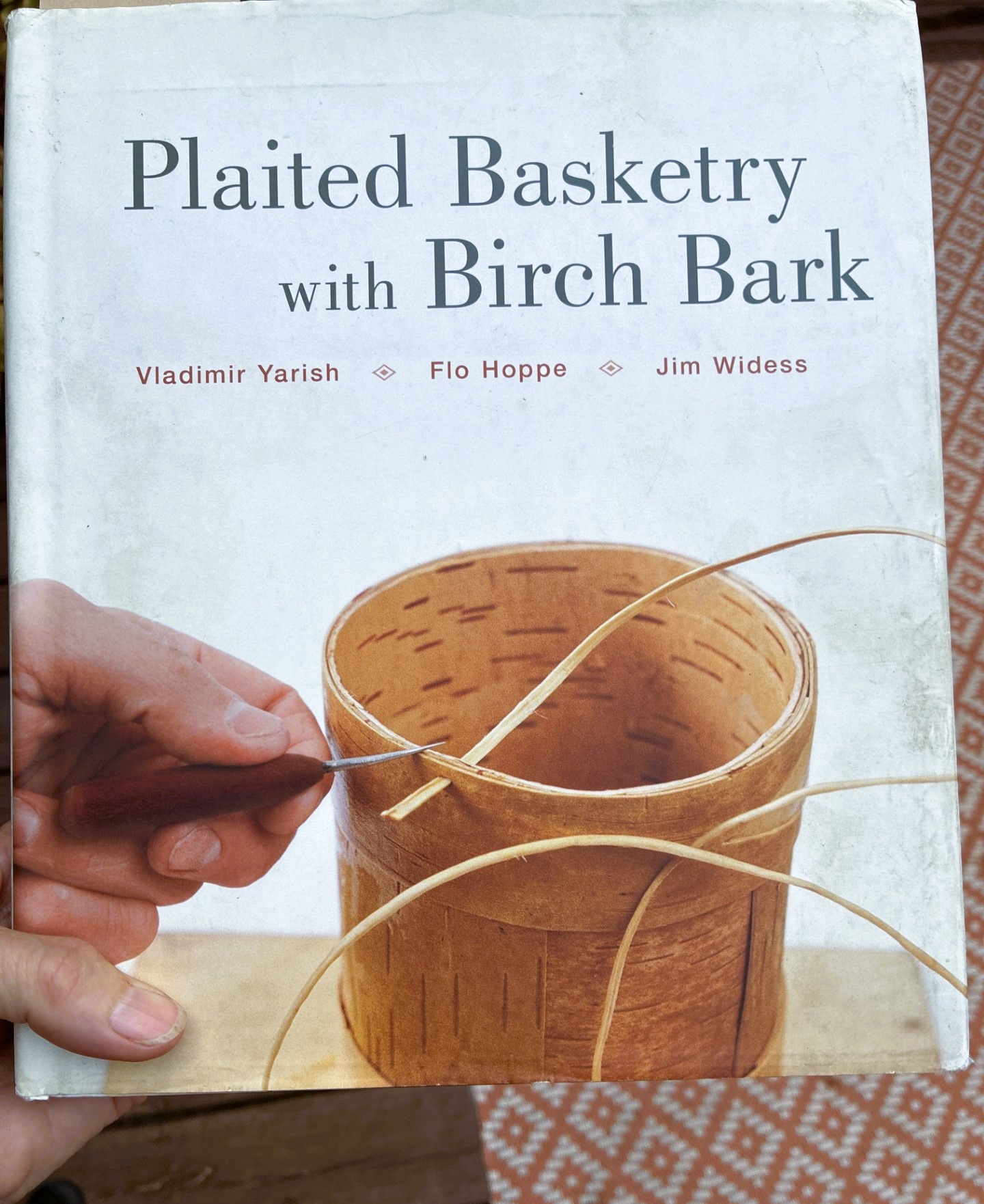
- Plaited Basketry with Birch Bark book
Straight weaving goes straight up and down and you have squares where the bias is like diamonds. I wanted to research it. I found out some really cool things that hook in with the Finnish culture. I kind of knew them, but I wanted to make sure.
It says in Vladimir’s book that in Norway, artisans produced canisters, boxes, and bags from birch sheets until the early 16th century when Finnish immigrants introduced weaving. I didn’t know that. So I’m thinking that they’re attributing this type of weaving to Finns. I knew it was all over in the Nordic cultures, but not specifically Finnish. So this is really relevant for me teaching at this Folk school.
(Karen’s reading from the book.) It says, “Items from plaited bark have been found in archeological sites in Finland. It is thought that the technique of plaiting was brought to Sweden by Finnish colonization beginning in the middle ages.” So again, it’s confirming. I was going to do this anyway, but I’m glad that I actually read my book.
dE: This is so cool.
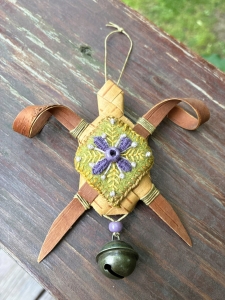
turtle ornament with stitching
KT: Living here with all the people of Finnish heritage and feeling the need to be proficient in this type of weaving (which art sales helped with) I would make all of these fun little items. I love to stitch so I made these cool little turtles.
The next piece is what I’ll be teaching on September 19th for the Folk School. It has a driftwood handle and copper nugget washers.
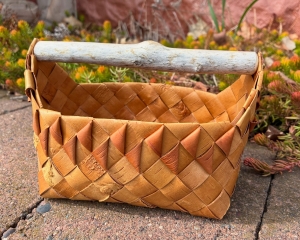
curly basket with wood handle
dE: So what’s that? Is it folded over? What’s that extra bit there? The textured weaving.
KT: That’s a curl. Isn’t that fun?
dE: Yeah, that’s great. How long have you been living in that area, Copper Country with the Finnish community?
KT: Oh, ’99 we moved up.
dE: What about the age range of students? Is it pretty varied?
KT: Typically adults. Typically adults, but it varies. The age from maybe 16 to 80s. I don’t know if we’ve had anyone in their 90s, but yeah, it’s going really well. So I really enjoy it. And now I can tell them that it appears that this weaving began in Finland. Because when it’s your culture, it’s like, “Oh yeah, everything came from Finland.” You know what I mean?
The National Basketry Organization contacted me to teach next year. So I’ve signed up for two conferences next year. One’s in April, Shenandoah Creates.
dE: That’s not that far from me. You were out there before, right?
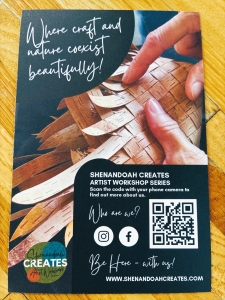
those are Karen’s hands
KT (holding up a program book): Those are my hands. I’ve taught for them twice already. I’m teaching there in April; it’s a very good venue. See, I’d rather teach at these smaller venues than at conferences anymore. I kind of just got burnt out on all the time-consuming and laborious preparation, plus I’m not as young as I used to be.
Here’s something I wanted to show you. It’s a large canister with eco-printed patches and a cool dovetail joint.
dE: That is amazing.
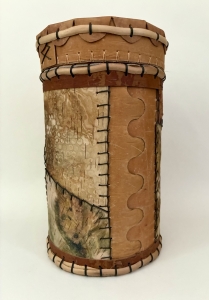
canister with dovetail joint
KT: I learned that from a Russian basket I bought and finally just took apart because I had to figure out how to do it. It’s lined; it has a wooden base; the rims are spruce root. This canister will be taught at the NBO conference next June in Shepherdstown, West Virginia (it’s a smaller conference.)
My friend Birchbark Beth – Beth Homa Kraus – is going to teach for National Basketry Organization with me next June as well. She teaches regularly at the North House Folk School in Minnesota. Folkschools like North House and John C. Campbell Folk School have been around forever. Now we’re seeing a Folk school boom.
dE: And I’m so happy about it. I really am. We need it.
KT: We have a lot of new young people in our Buellwood Guild, and at my Folkschool classes. They bring such great energy. They’re open to trying new things and exploring traditional techniques.
You can read more about Karen Tembreull’s history and the path that led her to teaching basketry at conventions here: Karen Tembreull: Master of Natural Fiber Basketry. Follow Karen on Instagram @barks.n.roots to see what she’s doing next. You can also follow @finnishamericanfolkschool and look into Shenandoah Creates Basketry for upcoming events.
 debora Ewing writes, paints, and screams at the stars because the world is still screwed up. She improves what she can with music collaboration, peer-review at Consilience Poetry Journal (based in the UK), or designing books for Igneus Press. deb is on the editorial board for Berlin-based Beyond Words Literary Magazine. Follow @DebsValidation on X and Instagram. Read her self-distractions at FolkWorks.org and JerryJazzMusician.com.
How to Find the World in Your Community – Basketweaving with Karen Tembreull
NUMBER 51 - Next-level basketry, traditional to gallery (not underwater.)
September 2026