Cast Iron Shoes: Analogue, please!
in which Nicole Ridgwell talks about AI, borders, intent, and what could be career advice for creatives
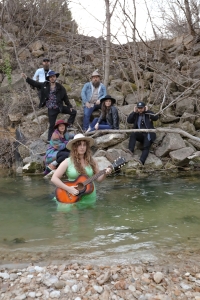 I don’t know what to call the music I like: Hard folk. Punk Folk. Death Folk. Americana with a sledge hammer. Strings, wood, and metal with a dusty floor and a bit of grunge. What makes it Folk is the story it tells: hard-luck and road-weary, living out of sheer spite. Outrage at injustice. Real stories of real folks and all the uncomfortable furniture that entails.
Cast Iron Shoes is described as a fiddle-driven alt-country rock band from Austin, Texas with songwriting that draws on Folk, Swing, Blues, and Appalachian influences. They forgot old-time Dixie jazz. This band makes a sound that soothes my mind – just edgy enough to feel mildly threatening, but soft enough to curl up and take a nap. You can decide if I’m describing my mind or the music. This is a place where truth is messy but irrefutable.
Singer/songwriter/fiddle player Nicole Ridgwell is the bandleader. Ringleader? I talked with her over Zoom while I sat in my office space and she sat in her car.
Our conversation wove through vintage gear, honesty in art, our love of vinyl, AI music, the little death of promoting your own work, goals and what grows in the deepest parts of Texas. I’ll share some of that with you here.
me: You have a lot of death in your music. But I like that about it: Death is a very real part of the lifecycle, and I don’t see any sense in avoiding it as a topic.
Nicole: It doesn’t avoid us.
me: Exactly. One of the things I really like about your lyrics is that you use little things…like in “Junebug”:
I saw a Junebug / I saw a thunder cloud
and
I don’t need no big stage, no marquee with my name
I tell people that tangible items are where we hide our feelings. I found that the items you choose to mention make the scene physical so I can go there. Lots of dirt…I love dirt. And then there’s that grungy mix… So how did you decide you needed everything to be analogue?
Nicole: I hate screens and I hate digital. I hate the fucking internet. And any time I tell people that, they say it’s useful and this and that… I just don’t feel like it is.
I grew up in a trailer with no electricity, off-grid. We didn’t have running water and we were really poor. We didn’t have electric, I didn’t play video games; I played instruments, and I read books. That was my childhood: playing and climbing trees. I wasn’t even exposed to computers until I was a teenager in junior high and they had us do typing class. That was my first interaction with screens. So it’s always felt imposed on me and not natural. I’ve always gravitated towards real things, like things that I can touch. For example, you’ll never find synth in my music, you know what I mean? I want a honky-tonk fucking piano. I like the sound of strings hitting wood.
me: The title track, “Bound to Flood” – I love that it starts out and ends with drums. How did you choose the title track?
Nicole: I knew I wanted the album to be called Bound to Flood, because drought/flood is to the land how feast/famine is to an addict. Too much/not enough relationships and substance abuse issues appear in almost every song on my album. Thematically, that song’s lyrics are a warning against the type of love you end up running from.
The song sonically sits between the deserts of Terlingua and the swamps of Lafayette. It’s a border song: you have to cross borders to run away.
The idea of Bound to Flood has been sitting with me ever since I came to Texas on my first tour. We were in Abilene and stopped at the gas station. The attendant told us the town hadn’t seen rain in seven years because God was angry at them. Their lake was all dried up. Then as soon as we crossed the county line it started pouring rain. I wrote about it in a song called “Abilene” years later but it didn’t really do the concept justice. I ended up writing multiple drought/flood songs; none of them felt like the one until I wrote “Bound To Flood.”
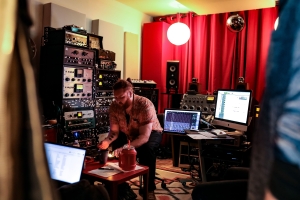
When I finished it, I knew it would be the title track. But it actually was the most difficult song to do the instrumentation for. I had no idea how I wanted it to sound – everything I tried was wrong. I thought it would be really swampy; but Aaron came up with the idea to bring that Spaghetti Western-style guitar tone and bring the desert into it and the whole song clicked into place. Max nailed it the first time he tried it we all got shivers up our spines.
It’s actually the only song on the album that I didn’t do all orchestration and instrumentation and production myself – we ended up using drums, bass, guitar, accordion, fiddle, and banjo. Aaron really put his stamp on it with that guitar tone. I think it makes the whole song.
(please enjoy this live version of “Bound to Flood”):
me: Let’s talk about your song “Don’t Let Me Go Back.” I like being able to hear the room. It sounds like a midsize garage with a mid-level of garage-things stored in there. This track caused me to think a lot about mixer pre-sets where you can choose “concert hall” or “house concert” for the music you play on your own system. I understand somebody went through a lot of trouble to figure out how to make the computer sound like a concert hall or sound like an intimate venue, but does it really sound like a concert hall or does it sound like a cartoon of one?
Nicole: I mean, I think it just goes back to what are you singing about? To me, I’m singing about what I have access to and what I don’t. If I don’t have access to a concert hall, it wouldn’t really make sense to make the mix sound like it’s in one. I’m not in one. And that’s lying.
Before I was a songwriter, I was a visual artist. I was an animator, I was a filmmaker, and I wrote stories. I’ve written screenplays, I’ve done all this shit. And I feel like anytime I’m working on anything, it’s only just me trying to be truthful to what that thing is. That thing already exists and it chose me to make it.
me: I say this all the time.
Nicole: I don’t want to be trying to make it something that it’s not. That’s what happens to me in my life. I have felt like an outsider. I’ve felt like it’s always “you’re doing this the wrong way” or “you need to be like this,” or you need to change this part of yourself, or you don’t really fit in. I don’t want to do that to my songs. If this song is trying to be one way, I don’t want to try and force it to sound like it’s in a fucking concert hall.
Most of my songs are written about underdogs and underprivileged people that fucking bang their heads against brick walls trying to get a chance, because that’s been my experience in life. And so to make something polished would be defeating the point of my actions. Being alive is not polished; it’s messy and embarrassing and uncomfortable and violent and dirty.
So that’s how my music sounds: because I grew up in the places where the dandelions grew through the cracks in the pavement next to the barbed wire fence. There was a sliding glass door into a trailer. Always liked the beauty of that.
me: I said earlier that your lyrics are very visual. Do you still do visual art?
Nicole: No, not at all.
me: By choice or just because you’ve been too focused on music?
Nicole: I stopped by choice. I worked in the film industry for seven years, animation for large corporations, which sucked the joy out of it. I thought I’d be able to exist in a corporate environment coming from where I come from and being who I am and being the kind of artist that I am. And I got pretty far and I was able to have an impact on some of the films, but it was hard for me to not try and make things better, to just be efficient.
me: Efficient. I’m glad you used that word.
Nicole: I don’t need people to like my music and I don’t need to climb this ladder. People have been asking me that a lot because I’m doing a full release with Bound to Flood. With Cast Iron Shoes, my first album, I just put it out there. I was like, I have an album. I just want people to listen to it. But this one, I’m gonna do all the releasing things and send it to DJs and stuff like that. And people are like, well, what’s your goal? When they do that, I answer: My goal is to make a record.
I always wanted to be a songwriter, and I always wanted to be a band leader, and I never had the confidence. I was always playing backup. I would play fiddle in other people’s bands and sing backup vocals, and I just felt like I would never be as good as the songwriters that I worked with. And the thing is, it doesn’t really matter how good you are. It’s process.
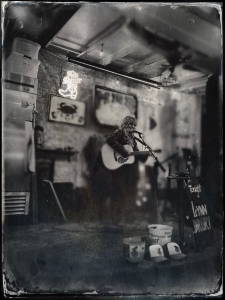
It’s the work that you put in every day. Wanting something to be good usually ruins the act of making it, and it’s not that fun anymore. Once I let that go and I didn’t need to be better than other people, then all of a sudden when I get criticism, it doesn’t hurt that bad. I don’t really mind if you don’t like this song. I wrote five more last week.
The whole need to evaluate everything, I think, has made music sound perfect now. And that’s why AI can dupe. The only reason we have AI being able to make music is because it’s become so perfected that it sounds like a computer. If your music’s not perfect or if you’re performing it live in a room with your fingers and your voice – those mistakes, and it just being what it is and not needing to impress other people, has been a journey for me. It’s freed me up to find a little bit of joy instead of being miserable.
I think goals are very overrated. They say we need them and we should always be striving towards these things and “where do you see yourself in five years?” How about where do I see myself now? What do I enjoy about my life? What am I proud of that I already did this year? Why are we sitting down making New Year’s resolutions for all the things that we could do better next year?
How about at New Year’s we sit down and list everything we did fucking awesomely this last year and pat ourselves on the back?
I did a whole bunch this year, and it might not be the shit that everybody else wants me to do or thinks that I should do or thinks that I could be more successful at, but I’m proud of it. I worked hard. Everybody offers some kind of constructive criticism: This is how you can get better. Maybe I don’t want to get fucking better. Maybe I just need a compliment. Maybe I just need you to say, “Good job, Nicole. You have value.”
me: My blog usually focuses on working as a musician and a visual artist, because I got a lot of mixed information growing up. My grandma was an artist, and so she encouraged that in me. But people would always ask, “What are you going to do for a career though?”
If somebody feels like a creative, I want them to know that yes, you should do that. I want anybody who’s raising children to tell them, “You will have more than one career. Let one of them be your passion. Yes, you can do the thing you want to do.”
Nicole: That’s always been my experience. I think I sold my first painting when I was 12 or something. I started teaching music lessons and playing on the street, like busking. I started sneaking into the art schools and drawing, and then I got internships at these animation studios. I always supported myself as an artist. I worked in some coffee shops and stuff, but always either teaching music, teaching art. I performed at kids’ birthday parties, and now I’m a full-time musician and I don’t do visual art at the same time, but I always had those two careers going at the same time, art and music. And I would lie in the music world, I wouldn’t tell people I was an artist.
me: That! Isn’t it interesting?
Nicole: Nobody knew I was a musician. Well, this last tour I did in California with my band, I performed at Pixar, and this is the first time I’ve been back to Pixar since I quit.
We performed on stage, and I was there as a musician, not as an employee, not as an animator. It was the coolest experience, and everyone was so happy for me. They said things like, “oh, this makes so much sense. You seem so much happier.” And it was the first time too that I was able to be my full volume. I have a loud voice. I don’t know if you can tell over Zoom, but I always had to make my voice less loud. It was too loud and it would disrupt things, and I took up too much space.
So when I went back there with my band, we were amplified. We had a fucking Telecaster. I screamed, I yelled during my set and I had this feeling of: Oh, this is what it feels like to be my full self in this building.
And it took me a long time to get myself to the point where I could be this volume.
Read the full interview here: Cast Iron Shoes: Bound to Flood
If you’ll be at Folk Alliance International in New Orleans, come find both of us. Make sure you follow Cast Iron Shoes on Youtube and Instagram @castironshoes so you’ll know where Nicole Ridgwell has landed. It’s sure to be somewhere interesting, maybe prickly and dry, and surely bound to flood.
I’ll leave you with the same last words Nicole gave me: Don’t forget you can fly.
debora Ewing writes, paints, and screams at the stars because the world is still screwed up. She improves what she can with music collaboration, peer-review at Consilience Poetry Journal, or designing books for Igneus Press. Follow @DebsValidation on X and Instagram. Read her self-distractions at FolkWorks.org and JerryJazzMusician.com.
Cast Iron Shoes: Analogue, please!
in which Nicole Ridgwell talks about AI, borders, intent, and what could be career advice for creatives