
Lúnasa, May the Road Rise to Meet Ye
The Irish band called "Celtic royalty," coming soon to a town near you
Crawford says that he sees himself primarily as a melodist, but aye “We discard more melodies than we keep,” he says. “Sometimes, this one or that one will be too modal, for instance. Trevor and Ed might say, well, we like that fine, but we can’t enhance it in any way. So, it doesn’t make the cut, at least not that time.”
When I spoke with Lúnasa band member Kevin Crawford on the evening of Shrove Tuesday — you may know it better as Mardis Gras — snow was falling at his home on the Hudson River near Woodstock in upstate New York as twilight rain fell in Pasadena. Crawford declared, “I have not had a Shrove Pancake since I left West County Clare!”
Lúnasa, praised by MOJO magazine as “the new gods of Irish music” and by the Boston Herald that stated “Lúnasa reigns as the new Celtic royalty” among other accolades, sets out on a six-week coast-to-coast tour beginning February 20, including a stop in Pasadena on March 21st, courtesy of the Pasadena Folk Music Society.
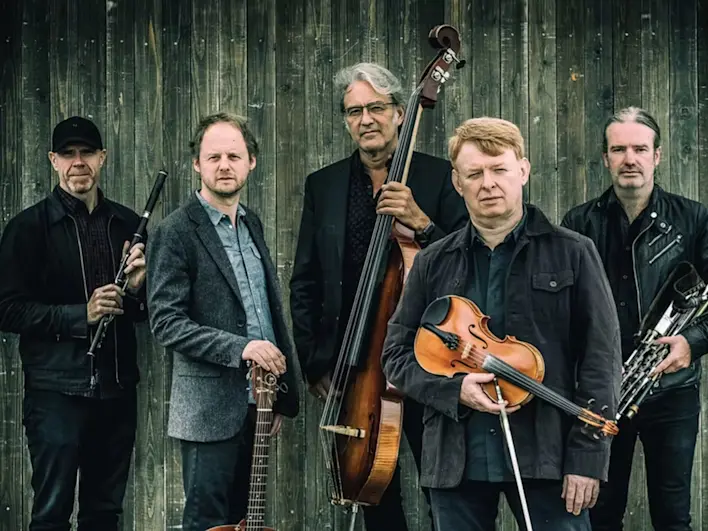
The current band lineup features frontman Crawford on flutes, whistles and bodhrán, Ed Boyd on guitar, Trevor Hutchinson on double-bass, Cillian Vallely on pipes, and Sean Smyth on fiddle. Crawford joined the band in 1997, and has also recorded several solo albums.
Here’s a preview:

While his Lenten observance may have gone the way of the Megaloceros, Crawford, age 58, has a fondness for some of the old ways, musically speaking. “I don’t want to be this curmudgeonly old sort, but today Irish music doesn’t sound the way it used to,” he says.
He seems to audibly cringe when discussing Ed Sheeran’s hip-hop-ish monster hit Galway Girl, and says, “Is this what they think our music is really like?”
Observing that Lúnasa came to prominence in the same era as The Chieftains and Riverdance, Crawford says, “On a very basic level, acoustic Irish music is accessible. There’s a compulsion to tap your foot on the pulse of it, and the sound itself, even without words, grabs you with this broad range of emotions. The sounds tell stories of real life, daily toil, even the weather. It might start out fine and airy, but then it turns heart-stopping.”

Kevin Crawford on flutes and whistles is the breath of Irish band Lúnasa. Photo: Lúnasa
He’s also not fond of the way some contemporary Irish bands superimpose reggae beats or jazz progressions onto traditional forms, choices he calls “artificial affectations. I hate when Irish instruments do interpretations of pop stuff. This music is a living thing, of course,” he says, “and it’s allowed to change. But this cheapening of the arrangement just to broaden the audience, I suppose, it’s just not needed. People respond to qualities in Irish music which can sustain modernizing, but still hit close to the root, ya know?”
Crawford says that the sound has indeed evolved from the way Irish music was played prior to the 1960s. “They used to be much larger ensembles of performers, with lots more fiddles and that. They played in unison in a more repetitive way, because the music really was intended for dancing. So what we’re doing is more for the audible aspect, shaking it up a little. Our way, with our smaller group, allows us to color and elevate the accompaniment, weaving around the melodic pattern in a sympathetic way. I’m thinking of Ed (Boyd) and Trevor (Hutchinson), for example. In our arrangements, everybody is heard, so the music is not just the trashy-bashy, raucous pub stuff. It’s more sophisticated now, but keeps its Irish integrity.”
He listened to the bands Planxty and Ossian as a lad, and has a fondness for bluegrass. “Flatt & Scruggs, Bill Monroe, that whine and drone, that high lonesome sound, it sounds so Irish to me,” he says.
To his earlier point, he says “The largest growth population for Irish music is in Japan. They’re mad for it, utter superfans, I think in part because we don’t have a singer, so there’s no language barrier whatsoever.” He’s amused and tickled that Japan is home to numerous “brilliant” Lúnasa cover bands, perhaps inspired by Lúnasa’s release Live in Kyoto, recorded at the legendary Taku Taku club in 2023.
He’s also an admirer of Jim Malcolm, Scottish songwriter and singer who visited Pasadena on February 14th. Crawford says, “I like the Scottish singing for that sort of beautiful hardness it has.”
The presence of sympathetic (in the instrumental sense) accompaniment, says Crawford, is key to the appeal of Irish music in its least contrived form.
“So much of the newer Irish music places such emphasis on technical proficiency, it’s almost too much for its own good,” he says. “In my years of doing this, I’ve learned something important. That is to know the difference between the kind of playing you must do to build and learn your skill as a musician, different from playing as a performer. As a musician, to be any good at all, you have to put in the work, no doubt. I myself have been something of a perfectionist in that way, when I’m practicing and working something out. But when you have it down, then you can let it be a bit imperfect. It’s that imperfection, if you will, that makes it so human.”
This is especially significant in playing wind instruments.
With a chuckle, Crawford recounts the time he was approached by a young violin prodigy who wanted to quickly learn the flute in order to compete in an upcoming championship. “This cocky young kid says to me, well now, the flute must be a lot easier to play than the fiddle, am I right?” With some reticence, Crawford agreed to give the young man lessons via Zoom. “So, he shows up a week later with this extremely rare, $12,000 flute,” says Crawford. “We started out fine, but soon he was telling me that he was light-headed and almost passing out! I told him it was because he had not learned breath control, which takes time.”
And perhaps a much-needed bit of humility.
Crawford’s knowledge allowed the young aspirant to perform with a small group. “Sustaining breath is definitely a skill, but Irish music is more forgiving than most,” he says. “In 4/4 time, let’s say we’re playing a reel, the 1 and the 3 are the important beats. You can actually lose beats 2 and 4 if need be, so you can catch your breath. So he was able to get along by following a more percussive style, on the 1 and the 3,, without hyperventilating and falling over.”
He says, “Even a melody or tune needs a rest now and again. There’s this whole palette of Irish ornaments we can use when we need to take a pause, so we fill in with these little gestures, then get back on the beat. These spaces between notes give the listener a moment or two to feel where the musical line is going, and sort of fill in their own response in the break, connecting the dots in a more personal way than you can do with a super-processed, super-produced sound, where there isn’t a breath of air.”
Lúnasa performs with virtuosic polish, yet retains a vigor that feels improvised. These songs seem a thousand years old, made conversational with an occasional rest or key-shift, like slivers of daylight through the gaps in an old fieldstone wall. Unlike a formal stroll on swept paths through a manicured English garden, where a fallen leaf disrupts the immaculate design, their sound is more organic and rambly, dotted with uninvited thistles and irrepressible shamrocks, where magpies swoop to snatch a mossy tuft for the wee hidden nest.
Like every artist, Crawford recoils from AI. “We’re all being fed this very homogenized diet of synthetic music with Spotify and what have you. What we do as a band could not be called rough, exactly. There aren’t rough edges, but we do allow for some asymmetry, I suppose. This allows for a little spontaneity, and a few surprises along the journey.”
Our conversation comes to an end and Janey Mack!, a rainbow arches over the foothills as we say goodbye.
DEETS
- Lúnasa concert
- Saturday, March 21st, 7:30 p.m. – 10:00 p.m.
- Westminster Presbyterian Church, 1757 North Lake Avenue, Pasadena 91104
- info@pasadenafolkmusicsociety.org
- Tickets HERE
Lúnasa, May the Road Rise to Meet Ye
The Irish band called "Celtic royalty," coming soon to a town near you