

American Music: Rooted in Cultural Fusion
From FolkWorks newspaper archives Volume 1 Number 3
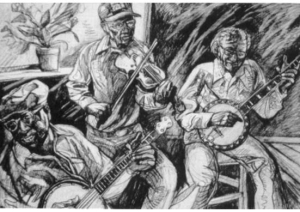 The fusion of European, African, and Native-American music is the root of all American popular music from blues to bluegrass, from jazz to rock and roll and country music. The prevailing image of white/black relations in the American South is shaped by the disasters of slavery, segregation, racism, and the rest of the baggage of white supremacy. But there is also an undercurrent, a counter-melody of cross-fertilization, cooperation, and collaboration. While that countertrend has received attention in the political sphere, notably in the civil rights movement, the meeting of the music of Americans from Europe and from Africa is less well known.
Africans brought the instrument which became the banjo with them on slave ships. In the Caribbean, that instrument evolved into what became the banjo and then it migrated north to the United States, though one scholar, George Gibson, finds banjos in Kentucky as early as 1800. Eventually, enslaved people taught the first European-Americans to play, most likely the early minstrels, such as Joel Sweeney and Dan Emmett. Howard and Judith Sacks argue that Emmett learned “Dixie” from his African-American neighbors in Ohio.
Africans also learned to play the fiddle, and there is much documentation—primarily in advertisements about runaway slaves who fiddled—that African-American fiddlers might have outnumbered their European- American counterparts. Dena J. Epstein cites two slaves playing banjo and fiddle together on a boat in 1774. The legal prohibition of drumming by African slaves in the southern states inevitably channeled African-American music into banjo and fiddle, along with other instruments such as the panpipes and bones.
The banjo brought with it African rhythms and playing styles. African-American fiddlers brought syncopation and polyrhythm to fiddling, as well. It is precisely these contributions which make American music unique and distinct from the music that came from Europe.
Bluegrass founder Bill Monroe always credited African-American guitarist and fiddler Arnold Schultz as one of his two major influences, the one who put the blues in bluegrass. (The other was Monroe’s uncle, old-time fiddler Pendleton Vandiver.) As a boy, Monroe accompanied Schultz at dances. Although there are no recordings of Schultz, he is believed to have influenced many other guitarists such as Merle Travis. In the liner notes to his LP, “The Old Timey Rap,” Virginia old-time multi-instrumentalist Hobart Smith recalled: “First of the guitar-playin’ I really liked was when a bunch of colored men came in there; I was fourteen or fifteen years old. It was along about that time that Blind Lemon Jefferson came through and he stayed with the other colored fellers, and they worked on the railroad there and he’d just play and sing to entertain the men in that work camp. I liked his type of playin’. I just watched his fingers and got the music in my head, then I’d thumb around till I found what I was wantin’ on the strings.” That would have been in about 1911 or 1912. Elsewhere, Smith reported that he learned to fiddle from an African-American fiddler. Other old-time musicians, such as Tommy Jarrell from North Carolina, remembered that some of the tunes they played came from African-American sources.
When A. P. Carter of the Carter Family traveled through the South collecting songs, he brought with him Leslie Riddle, an African-American musician, to learn the melodies while Carter took down the lyrics. John and Alan Lomax traveled with Huddie Ledbetter, better known as Leadbelly, who not only served as their driver, but also helped the Lomaxes to locate traditional African-American musicians. Mississippi John Hurt used to play for dances with his neighbor, Willie Narmour, who was a fiddler. When Okeh recorded Narmour and his partner Shell Smith, they were asked about other good musicians in the area (Avalon, Mississippi), and they immediately recommended Hurt.
DeFord Bailey was one of the stars of the Grand Ole Opry from 1925 to1941. He toured with Uncle Dave Macon, Bill Monroe, and Roy Acuff, who sometimes had to resort to subterfuge to get Bailey into whites-only hotels. NPR sports commentator Frank Deford described Bailey as a black man who played white hillbilly music. But he was incorrect. The music Bailey played belonged equally to blacks and whites. Although today it is often associated with the Appalachian descendants of European settlers; it was widely played by African- Americans, as well, until World War II. That tradition, though almost gone, still survives in musicians such as Mebane, North Carolina, fiddler Joe Thompson who recalls going with his father to play for square dances, which Joe calls “frolics,” in white homes.
Perhaps the most remarkable evidence of musical sharing between blacks and whites is in five commercial recordings made in the 1920s. Jim Booker, an African-American from a musical family, recorded four tunes as the fiddler with Taylor’s Kentucky Boys, the rest of whose members were white, including noted banjo player Marion Underwood. Booker was simply the best fiddler in the area. Andrew Baxter was an African-American/Cherokee fiddler who recorded one tune, “G Rag,” with the Georgia Yellow Hammers. Baxter’s heritage reflects the fact that intermarriage was very common between African Americans and Native Americans in the South and that Native-American music is likely fused into the mix, too.
There are some other famous black/white recordings. Jimmie Rodgers, Louis Armstrong, and Earl Hines were in a recording studio in Los Angeles at the same time, and Rodgers’ producer had the idea of having them record one together. Cajun greats Dennis McGee and Amadee Ardoin recorded together, as well. (Patrick Huber’s chapter in Hidden in the Mix, cited below, is entitled “Black Hillbillies: African American Musicians on Old-Time Records, 1924–1932” and contains many more examples.)
There are just enough recordings of African-American old-time musicians to hint at the breadth and variety of their tradition. Ironically, it was offshoots of old-time music, such as blues and ragtime, which engendered jazz, rhythm and blues, and rock and roll, and enticed the next generations away from their traditional music. It is likely that blues began on the banjo, but the introduction of the guitar quickly displaced it. The fiddle, too—and Lonnie Johnson is a good example—was largely replaced by the guitar. The number of musicians—black and white—who grew up immersed in tradition is rapidly dwindling. The preservation of those traditions is increasingly left to so-called revivalists, who often grow up and live far from the places where these musical traditions once thrived. Thus there is a danger that the history and diversity of tradition could be compromised or lost. That would be a tragedy, for it is precisely the cultural fusion in American music that makes it popular around the world.
Steve Goldfield wrote for the Old-Time Herald, Bluegrass Unlimited, and Fiddler. He also hosted the weekly radio show, “Shady Grove,” on KCHO and KFPR in Chico and Redding, California.
SUGGESTED READING
Dena J. Epstein, Sinful Tunes and Spirituals: Black Folk Music to the Civil War, University of Illinois Press (1977)
Tony Russell: Blacks, Whites and Blues, Stein and Day (1970)
David C. Morton with Charles K. Wolfe, DeFord Bailey: A Black Star in Early Country Music, University of Tennessee Press (1991)
Howard L. Sacks and Judith Rose Sacks, Way Up North in Dixie: A Black Family’s Claim to the Confederate Anthem, Smithsonian Institution Press (1993)
Cecelia Conway, African Banjo Echoes in Appalachia: A Study in Folk Traditions, University of Tennessee Press (1995)
Jim Rooney, Bossmen: Bill Monroe and Muddy Waters, Da Capo Press (1985)
Hidden in the Mix: The African American Presence in Country Music, Duke University Press (2013)
American Music: Rooted in Cultural Fusion
From FolkWorks newspaper archives Volume 1 Number 3