

Fado: The Soul of Portugal
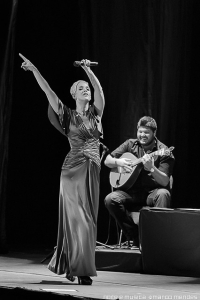 Fado was born in Lisbon. As was true of tango, rebetika and jazz in their own lands, fado was born in the bars and bordellos of the poor-est districts of the city, where it could be heard everywhere, even on street corners. It came into full flower in the 19th century, although its roots are far older, as old perhaps, as Portugal itself.
Only about two centuries old, traditional fado is based largely on a poetic theme of mournfulness and yearning. Accompanied traditionally by the haunting strains of one or two twelve-stringed Portuguese guitars and a classical guitar, fado could be described as pathos set to music.
I first heard fado as a young man over four decades ago, and recall exactly how I first experienced its impact. I was en route to teach a guitar class at UCLA. Already a collector and performer of music from many parts of the world, I used to keep the car radio tuned to a small Inglewood station that on Saturdays aired various ethnic programs, The Ukrainian Hour, The Armenian Hour, etc. Between sermons and advertisements sometimes I would be lucky enough to pick up some really fine music.
That morning I turned my car radio on to hear this haunting, deeply moving melody delivered through a truly captivating voice. I was so blown away that I had to pull to the curb. I could just make out the words “Portuguese” and “fado.” I had never heard the language spoken previously and had no way of knowing that the singer was Amália Rodrigues, Portugal’s greatest fado singer, or “fadista.” I had heard only one song and believe I actually physically ached to hear more.
As soon as my class was over, I began my search and, in the third record shop, was incredibly fortunate to find, in those times of relative musical insularity, a really fine fado album, one with three particularly fine singers…. a 33 rpm recording that I treasure in my collection to this day.
Fado has traditionally been sung by either men or women, both of whom are referred to as “fadistas.” The women traditionally wear a black shawl in memory of the greatest early fado singer, Maria Severa. Though the music is predominantly sad, expressing as it does the concept of “saudade,” a largely untranslatable Portuguese word that can only be loosely rendered as “a nostalgic, soulful longing for what may or may never have been,” not all fados are mournful. There are some that are whimsical and occasionally even humorous.
There is considerable dispute on the subject of fado’s birth. The roots of the music are to be found in several sources: ancient Provençal balladry, the songs and chants of Lisbon’s early Moorish and Jewish populations as well as in the musical influences brought back by Portugal’s mariners during its Golden Age of Discovery. It was this same Maria Severa, however, a singer of Gypsy birth, who is largely responsible for fado’s move from the streets and bars of the lower class neighborhoods into the drawing rooms of the rich, and into the salons of the nobility.
This flamboyant and tempestuous lady was involved in a highly publicized love affair with a prominent nobleman. Their scandalous relationship stimulated much interest both in the singer and in the fascinating new music she performed. The middle and upper classes wondered, “What was going on down there?” and began traveling to the colorful Mouraria district where Severa could be heard.
Fado’s Golden Age took place in the first half of the 20th century, but it fell into a deep decline in the late 1960s, after the fall of the Salazar dictatorship in Portugal. The young people refused to listen to it or sing it as, in their minds, it was linked, somehow, to the dictator’s fascist regime. On my visits to Portugal during that period, there were few younger people listening to fado; no new young singers emerged and I greatly feared for the future of this enchanting music.
In the last two decades, however, there has been an explosion of interest in fado on the part of young Portuguese, who have come to realize that it represents a significant part of their musical heritage. With the Internet has come a surge of interest in world music with clubs opening world-wide.
With this revival of interest in fado has come an array of outstanding new fadistas, such as Mafalda Arnauth, Mariza, Misia, Ana Moura, Cristina Branco and Dulce Pontes, to name just a few. Mariza, an exotic, Mozambique born, top recording artist and dramatic performer with a great voice and style, will be appearing at UCLA’s Royce Hall on October 19th. Another great Portuguese singer, Dulce Pontes, who performs wonderful fado but has extended her talents and radiant voice to other music forms as well, will be appearing at the same venue on November 5th.
Many of these singers have begun to sing newly composed fados and added new arrangements and accompaniments using a wider array of instruments, such as piano and woodwinds. These young singers have made fado popular with music lovers in other parts of the world and the Portuguese devotion to this gift from their musical past has risen to even greater heights. Recently fado has been acclaimed as a UN world cultural heritage. If you are already a fan of fado or if these ramblings have piqued your interest, then the UCLA concerts are a rare opportunity not to be missed.
Donald Cohen, a retired attorney and college history and music professor, guitarist and folklorist has spent his life studying, researching and collecting music from Europe and the Americas. One of his particular fields of interest during a large portion of this period has been the Portuguese fado. During these studies Mr. Cohen developed an extensive understanding and deep affection for the history and culture of Portugal and the Portuguese people. He has lectured extensively on the subject of fado on radio, TV and various educational institutions. Donald Cohen is the author of Fado Portugês: Songs from the Soul of Portugal.
Version 1.0.0
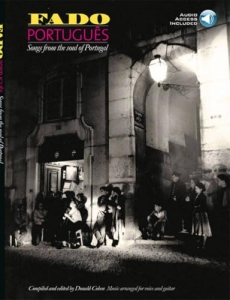
Fado Português: Songs from the Soul of Portugal
A collection of 26 of the greatest fado classics and a history of fado, together with musical transcriptions, guitar chords and lyrics in Portuguese with English translations. There are extensive annotations about each song and performer. The book contains many beautiful historic photos of Lisbon, the fado clubs and performers. Postcript materials describe the best places to hear fado and other valuable information. Best of all, the book comes with a great CD containing every song in the book performed by the original artists that made these songs classics.
The book is available from Amazon and through all major bookstores; it may be ordered from publisher at: info@halleonard.com
From the FolkWorks archives: Volume 5 Number 5