
In Performance – Both Sides the Tweed and Burning of the Piper’s Hut
Number 85, July 1, 2026
Last year I was introduced to the song “Both Sides the Tweed,” and wrote about it in my FW blog of April 1st, 2025 HERE
Over the last year since, my ensemble and I have integrated “Tweed” into our current show, “Diamonds in the Rough: Great Songs by Great Songwriters” that has been performed around Southern California since 2024. And during that time, we were invited to perform as guests of the Scottish Fiddlers of Los Angeles in their annual concert of last April 11, 2026. Luckily for us, the song was selected as one of our featured pieces to perform with the Fiddlers Orchestra.
I return to the song this month to offer the live performance audio from the concert, with the addition of a gorgeous instrumental tune as a lead-in to “Tweed.”
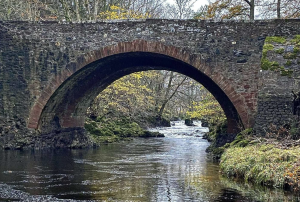
As I wrote last year, “Tweed” is a Scottish song of independence and political collaboration with its neighbors, with the “Tweed” in the title referring to the river which forms part of the Scots-English border. It is used here as a symbol of both the need for independence and the need for friendship and co-existence.
Recalling Some History: “Both Sides the Tweed” was adapted by the artist Dick Gaughan in 1981, but the tune history goes back to 1707. More specifically, the song speaks of the corruption involved in the negotiations leading up to the Act of Union of 1707, which linked Scotland and England.
Read More About the River Tweed Here which marks part of the border between Scotland and England; the song promotes the friendship and honor that unites us rather than hostility and control that divides us. It is a song and a sentiment that is particularly timely in our present day.
Though it was written so long ago, I believe that the song speaks powerfully to us now. The verses call for the recognition of Scotland’s right to sovereignty and the choruses argue against prejudice between our peoples. Those topics couldn’t be more fitting for the times we’re living in now.
 In our performance from the April concert with the Scottish Fiddlers of Los Angeles, we prefaced “Tweed” with an instrumental from fiddler Mark Indictor, “The Burning of the Piper’s Hut” by Alexander McKellar, c 1885, which refers to the 1745 Jacobite uprising against Britain and the brutal retaliation by the British afterward.
Common origins of this tune refer to:
The Jacobite Rebellions: Some suggest the name relates to the brutal aftermath of the 1745 Jacobite Uprising, which ended in defeat at Culloden and saw Highlanders severely persecuted. Read More Here
The battle of Culloden was a massacre which took place in less than an hour, start to finish. It had a profound impact on the clans in Scotland. Many clans were broken up, their lands and traditions taken away, and their leaders were either killed or fled into exile. The battle and its aftermath marked the end of the traditional clan system in Scotland.
From Musician Rivalry: Another popular story claims the name refers to an enraged fiddler who, disgruntled or jealous of a piper, burned the piper’s hut to the ground.
From Mark: “As far “The Burning of the Piper’s Hut” is concerned, it has been performed as both a march and a lament. In my opinion, that tune and “Tweed” show two diverse views of the aftermath of Culloden.”
My own experience of performing “Tweed” has been a profoundly powerful one, and I’ve been fortunate to have such a remarkable backing group as the New Folk Ensemble for our performance, along with the simply gorgeous sounds of the fiddlers behind me.
Here is our performance from April 2026 of these tunes in arrangement, featuring Mark Indictor on fiddle, Steve Rankin on Bouzouki, Fred Sanders on bass, myself lead vocal and guitar, augmented by the sublime playing of the Scottish Fiddlers of Los Angeles.
“Burning of the Piper’s Hut: Both Sides the Tweed”
Both Sides the Tweed
What’s the spring-breathing jasmine and rose?
What’s the summer with all its gay train
Or the splendour of autumn to those
Who’ve bartered their freedom for gain?
Let the love of our land’s sacred rights
To the love of our people succeed
Let friendship and honour unite
And flourish on both sides the Tweed.
No sweetness the senses can achieve
Which corruption and bribery blind
No brightness that gloom can e’er clear
For honour’s the sun of the mind
Let the love of our land’s sacred rights
To the love of our people succeed
Let friendship and honour unite
And flourish on both sides the Tweed.
Let virtue distinguish the brave
Place riches in lowest degree
Think them poorest who can be a slave
Them richest who dare to be free.
Let the love of our land’s sacred rights
To the love of our people succeed
Let friendship and honour unite
And flourish on both sides the Tweed.
Enjoy this video montage from the concert!
As always, thanks for reading! See you next time….
Love and Blessings,
Susie

Photo by Cam Sanders
Award-winning recording artist, Broadway singer, journalist, educator and critically-acclaimed powerhouse vocalist, Susie Glaze has been called “one of the most beautiful voices in bluegrass and folk music today” by Roz Larman of KPFK’s Folk Scene. LA Weekly voted her ensemble Best New Folk in their Best of LA Weekly for 2019, calling Susie “an incomparable vocalist.” “A flat out superb vocalist… Glaze delivers warm, amber-toned vocals that explore the psychic depth of a lyric with deft acuity and technical perfection.” As an educator, Susie has lectured at USC Thornton School of Music and Cal State Northridge on “Balladry to Bluegrass,” illuminating the historical path of ancient folk forms in the United Kingdom to the United States via immigration into the mountains of Appalachia. Susie has taught workshops since 2018 at California music camps RiverTunes and Vocáli Voice Camp. She is a current specialist in performance and historian on the work of American folk music icon, Jean Ritchie. Susie now offers private voice coaching online via the Zoom platform. www.susieglaze.com
In Performance – Both Sides the Tweed and Burning of the Piper’s Hut
Number 85, July 1, 2026