A Living Workshop: The Festival of American Fiddle Tunes at Fifty
By Jody Gunn
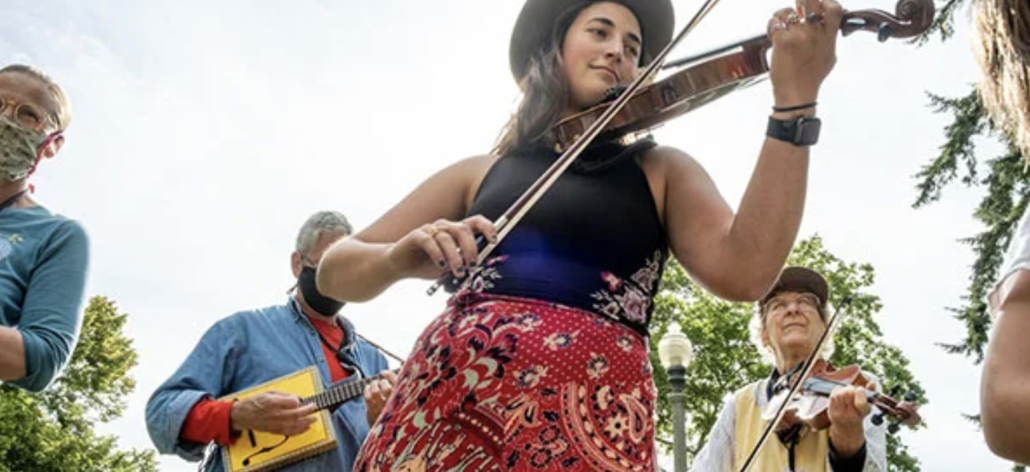
Traditional music is often described as something preserved. At the Festival of American Fiddle Tunes in Port Townsend, Washington, it can equally be described as something exchanged: taught in workshops, deepened in jam sessions, shared across styles, and passed from musician to musician. For fifty years, that process has remained central to the gathering. It takes place on the week surrounding July 4th: This year from Sunday, June 28 to Sunday, July 5, 2026
Since 1977, the Festival of American Fiddle Tunes has brought together musicians from a wide range of fiddle traditions for a week-long mix of workshops, dances, concerts, and late-night sessions overlooking Puget Sound. The gathering combines workshops and public performances, but much of its character comes from the musical exchange that continues throughout the week. Designed as a total-immersion experience, the festival includes workshops, dances, and informal sessions extending across the Fort Worden campus. The festival describes its approach as rooted in oral tradition, emphasizing listening, close observation, experimentation, and direct participation.
Despite its title, the Festival of American Fiddle Tunes ( known widely as Fiddle Tunes) has long extended beyond strictly American traditions. While fiddle music remains central, the festival has also incorporated accompanying instruments, singing, and dance traditions tied to regional styles. Over the decades, musicians associated with Irish, Scottish, Cape Breton, Québécois, Scandinavian, Cajun, Klezmer, West African, and many American regional traditions have participated. Musicians from different backgrounds and generations regularly cross paths there, with workshops, sessions, and shared learning remaining central to the event’s structure.
Founded in 1977 and presented by Centrum at Fort Worden State Park, the festival emerged during a period of renewed interest in regional and vernacular music traditions across North America. Fiddle Tunes emphasized direct participation alongside performance. Workshops formed the core of the experience, but so did dances, informal sessions, and the opportunity for musicians to interact throughout the week beyond formal classes and performances.
Over time, the festival’s scope broadened considerably. Historical festival descriptions from the 1990s already referenced traditions including Romanian, Greek, jazz, bluegrass, and Native American music alongside old-time and other fiddle styles more commonly associated with the festival’s name. Across different decades, festival programs and descriptions show a consistently broad mix of musical traditions.
Workshops remain central to the festival, but festival descriptions and participant accounts also emphasize the spaces between scheduled events: late-night jam sessions, hallway conversations, impromptu demonstrations, shared meals, and dances where musicians from different traditions encounter one another directly. Throughout the week, music continues in workshops, dance halls, residence buildings, and informal sessions across the campus.
Over the decades, the festival has brought together musicians from an unusually broad range of traditions. Artists appearing at Fiddle Tunes have included old-time musician Bruce Molsky, Appalachian and Cajun musician Dirk Powell, roots musician Rhiannon Giddens, old-time fiddler Rafe Stefanini, Cape Breton fiddler Jerry Holland, Irish-American fiddler Liz Carroll, Scottish fiddler Alasdair Fraser, klezmer violinist Alicia Svigals, Mexican regional ensemble Los Originarios del Plan, and Scandinavian group Fru Skagerrak. The range of musicians reflects the festival’s long-standing mix of American and international traditions.
At fifty, the Festival of American Fiddle Tunes continues to serve as a living workshop where musicians gather to share, teach, perform, and sustain traditions across generations. Fifty years later, direct exchange remains one of the threads connecting the festival’s many traditions and generations of musicians.
2026 registration for Fiddle Tunes is now closed but there are still plenty of opportunities to participate. Many concerts are open to the public. Jams and dancing into the late night are open. And, nearby in Port Townsend, there is the Mule Barn Camp. Some people camp there and drive or bike to classes and workshops, while others simply jam day and night throughout the week. It’s a lively, family-friendly setting with good facilities and a short walk to the beach. No reservations are needed.
A Living Workshop: The Festival of American Fiddle Tunes at Fifty
By Jody Gunn