Emmett Doyle’s Minneapolis
A Search for Current Protest Songwriters (and Finding the Best Jug Band)
 Every time I saw the question on social media, “Where are all the protest Folk singers?” I was surprised, then irritated: they’re everywhere. What kind of a question even is this?
It’s heartening that someone felt a need for music to unify our times, but folks…look around you! The revolution is being televised. We’ve been broken since COVID and #BlackLivesMatter joined forces, asking us to either stay inside or take to the streets in N95 masks with signs that shouted louder than our voices. Our communities changed, permanently.
But we’re in the thick of it all right now. The revolution is being televised. The Folk singers are hard at work.
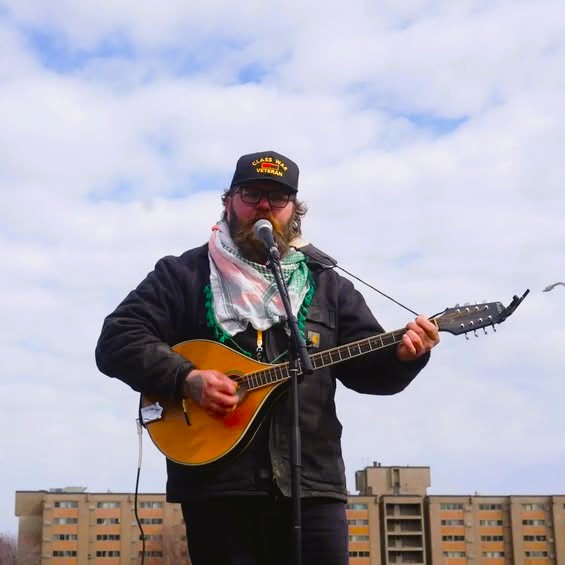
Emmett Doyle lives in Minneapolis near the Third Precinct. I interviewed him over Zoom on February 6, 2025.
debora Ewing (dE): So what’s going on over there?
Emmett Doyle (ED): Oh, well, quite a lot. Do you mean in general or musically?
dE: All of it.
Emmett: Oh, well, I got to say I’ve never seen the city as organized as it is right now in terms of just grassroots everything. It’s almost impossible to keep track of all the different work that people are doing. I’ve been a highly-involved grassroots organizer for years, involved in the Industrial Workers of the World, the General Defense Committee, the Workers Defense Alliance. I helped found Whittier Cop Watch…a lot of different stuff over the years, it’s just amazing. I mean, every day that I’m working, I have to choose between any one of two or three different meetings, different actions; then, if I’m not going to any of those things, making broader, specific demands – just the day-to-day work of mutual aid and mutual defense is all-encompassing.
On top of that, there’s the people who are going around bringing food to people’s homes, doing laundry for people who can’t leave because they’re afraid of getting kidnapped. There’s a crew of carpenters going around fixing doors that have been kicked in by ICE agents. There’s multiple different tow truck companies that are going people’s cars for free after they’re abducted, and there’s an ongoing 24-7 protest outside the Whipple building for weeks, as the Whipple building gets more and more fortified. I think we’re kind of at a turning point right now. I think we’ll see what happens.
But I think overall, metropolitans and the rest of us in the Twin Cities are feeling resilient. We’re not tired yet. We’ve been through worse than this before. We’ve been through 2020; that was shorter, more violent, more of a big social rupture and spasm. But we’ve built a lot of strengths and a lot of community with each other. So I’m hopeful.
dE: From the outside, a lot of people are fully cognizant that this could happen in our communities, too. There’s a large immigrant community where I live. Thank you on behalf of the Americans who care and are on your side. How is all of this actually affecting the Folk community that you’re a part of?
ED: Normally, when I’m going to an open mic, it’s what people come to expect when I’m up on stage. But it’s been the case for the last several weeks that basically everyone is as political as I am. I think the singer-songwriter showcases that Nick Hensley puts on every week – most of the time it’s basically an anti-ICE rally, because everyone has a new protest song. At the Chatterbox or the Terminal open mics, people might not be big singer-songwriters, but they’re pulling out all the old protest songs they can find. I’ve heard probably at least seven different covers of ‘Deportee’ by Woody Guthrie.
dE: This was going to be one of my questions, too: How much is historic protest tradition tying in? I did a thing last year January on the anniversary of the Los Gatos plane wreck on the theme ‘Deportee’, because even then we were looking at so many deportations. So what was going on in the Folk community? What’s different now?
ED: Well, before, on a typical night you’d always have at least a couple of protest songs, especially as things have been getting worse and worse. I would say, especially since Trump was reelected, it’s been a given that you’ll always have an anti-fascist song or two. Philippe, who runs the Chatterbox Showcase, always sings “Bella Ciao.”
That’s a standard that the entire audience sings together. Within these last couple weeks, it’s just been three or four times the density of protest songs in any given night, to the point that a lot of times if someone doesn’t have a protest song, they’ll be apologetic about it. “Hey, I don’t really have anything to say musically right now, but Fuck ICE – ICE Out. Anyway, I wrote the song about my girlfriend and I really love her…”
And it’s like, that’s fine, dude. You can sing that song too. We need Love.
dE: Something that’s been on my mind a lot: Everything is actually a form of love. Our anger is a form of love. Our hatred is a form of love, our disappointments, everything is love. You probably have some in your circles that will back that up.
ED: Yeah, I would say so.
dE: So… “Where are all the songwriters?” When I’ve seen that statement, I wonder what people are thinking when they post it. How much does this feel like it’s your responsibility?
ED: Oh, definitely. It feels like it’s one of my core responsibilities. I’ve been taking time off from other involvement in the resistance to try to get my songs finished. I figure now is the time. It doesn’t mean a whole lot if I have this commentary on what’s going on but it comes out after everything is done.
And so I’m trying to remind myself – I could be out commuting, which is the local term for patrolling in your car, looking for ICE agents. I could be out doing mutual aid, I could be doing this or that, but if I’m going to be writing these songs and telling myself I’ll record them, then yeah, it is a responsibility to do that.
And I think I feel that responsibility maybe more heavily because I’m already institutionally a protest singer. I have kind of mentorship/mentee relationship – I was once the front man of the WWS Local house band, the Wooden Shoe Ramblers, the biggest anarchist, accordion-driven Folk band in the Twin Cities, which you’d think might have more than one. We are that kind of town. But no, we just had the one; the rest were electronic projects.
dE: You would think.
ED: I think most of the creatives in the Twin Cities feel they have a responsibility to do something, anything. So we’ve got people doing textile arts and pottery; for example, I’m going to have my practice for Battle of the Jug Bands tonight, which is this wonderful—
dE: Oh, get the fuck out.
ED: Every year we have this great event: Battle of the Jug Bands, held at The Cabooze. You’re required to have makeshift instruments of some sort, a minimum number of authentic jug band instruments. I guess to get the vibe of what battle the Jug Bands is, it’s important to know that one of the rewards you can get is “Best Bribe” and—
dE: …wait, one of the rewards is what?
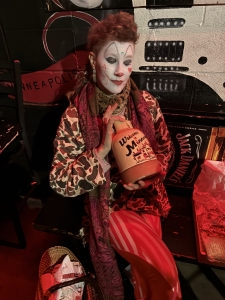
this clown was one of the judges.
ED: Best bribe. The band that gives the best bribe to the judges is rewarded. One person gave the judge a gavel one year and, of course, won “Best Bribe.” There was one time someone comes up with a tray full of muffins that they baked with $20 bills just sticking out of the muffins. So my Jug band, which is just my normal Folk band plus a saw player and a jug player (we wanted to hit our quota) will be performing with what we’re going to use as our bribe. We’ll be making a clay jug of moonshine with some kind of anti-ICE logo on it.
dE: Oh man…I need a picture of that.
ED: Yeah, we’re going to be filling it with moonshine that some of our friends are making because it must be authentic moonshine. I’m from Stearns County; we have a pretty strong moonshining tradition there. We’ll be taking that, sticking a rag in it, basically a big clay moonshine-powered Molotov cocktail. But I guess all that to say, even the ceramicists are getting in on it. One of the best: We have an annual art sled event where people make sleds that are art in some way.
dE: Yeah, we saw some of that. I mean, it is really heartening the rest of the country. I hope it’s heartening us enough that, when it comes to our towns (because I don’t feel our legislative branch is doing enough to stop it) then hopefully we’ll all be prepared. But we don’t have that cold-climate sense of whimsy; we have to tap into what we have. America can’t do something France, where everybody takes to the streets, it’s everybody. I was told that some French people said we’re doing it wrong by scheduling protests instead of getting out there every day until something changes. Our strength is our weakness, I guess in some ways.
dE: So why Minneapolis?
ED: Well, I’ve heard that question sometimes phrased as, “Why is it always Minneapolis?” but yeah. We are a city that in many ways sits at a juncture – of a lot of different industries, a lot of different industrial processes – and so of capital circulations within the US; a lot of cities do. We’ve got 3M, we’ve got Target, but then we also have a workforce with a very long, strong history of union organizing, of community organizing generation after generation.
We had the 1934 strike. We had the Union Defense Guard; we’re also the city that had the American Indian movement. We have a much longer history of Black progressive organizing than a lot of people recognize. They might look at Chicago or Oakland, but it’s been a consistent current here in Minneapolis as well. We have a number of immigrant communities – as much as the far right is focusing on our immigrant communities, some of the biggest immigrant communities here are mostly refugees who were thoroughly vetted, who’ve come in completely legally. It’s this bizarre fixation.
dE: It is a bizarre fixation. I know firsthand much about the immigration process. What ICE is doing has got nothing to do with finding illegals.
ED: It’s this counter-revolutionary moment where our city is seen as a hive of Black rebellion, progressivism, and of White race traitors. A lot of the vitriol directed online from right-wingers towards Alex Pretti and Renee Good is this fixation on, “They died for immigrants who don’t care about them.” If you’ve actually been to the memorial, the Somali community was one of the first to come out to the memorial with sweet tea and sambusas. They were feeding people.
They’ve been there mourning alongside us. Both the memorials are absolutely covered in Catholic Latino prayer candles. It’s beyond obvious that our immigrant communities here care deeply about us and we care deeply about them.
I think intercommunal solidarity is deeply threatening to fascism because the ideology is that you can only have solidarity with people who share the same culture as you. But the problem is that my hometown is like 10% Somali. Those are my neighbors, and they have been since I was a very small child. We’ve always had Hmong people and Native people and Latino people living alongside us; that’s not threatening to us, and we don’t consider them to be part of a separate culture.
This is our town, this is our culture. I think everyone here understands the federal occupation as an outside force that’s attacking us and our neighbors, even if they were born in Mogadishu or in the mountains in Southeast Asia somewhere. That’s our community.
dE: I think I’m hearing from you, which I think is great, that your definition of culture is multicultural.
ED: Yeah. As a musician, it really can’t be anything else. We as Folk musicians understand how our Folk roots blend and change over time. It’s easy sometimes for us to get into a narrative that Folk music is this timeless musical tradition that has within it this immortal spirit of a people and a land. And that’s not quite true. We know that, from an ethnomusicological standpoint, all of our Folk music is a mixing of different traditions from all the world.
dE: The way I like to say it is that Folk is what people make when they don’t have anything else. It’s music on the porch, whoever’s porch it is. Folk is evolving, always.
ED: If you look at Folk music as kind of this soil from which everything grows, also look at popular music you can say eventually, old genres of popular music start to lean back into the soil and sprout back up. What we call Folk music now is the pop music of the 1800s. And it was never this timeless thing. It’s always been this living tradition.
And so I think as we move forward, I think we’ll have to define some things as traditionalist Folk and some things as new parts of living tradition. I think that that’s just a process of our cultural creative commons reabsorbing the cultural product of the popular music. At their base roots, a lot of those genres are made in a very Folk music kind of way. Your local metal scene has a lot to do with basically being a Folk music community.
dE: I like that: reabsorbing.
ED: It’s just a bunch of people making music for and by each other. From that, maybe a couple of bands get big. I think that’s also why people are wondering “Where are all the protest songs?” A lot of people look back at the 60s and think, “Oh, back then there was all these great protest singers like Bob Dylan, maybe one or two other people.”
dE: Hindsight, though – it looks very clear from here, but it was messy while they were there.
ED: In retrospect. I don’t think that we’ve necessarily yet had our Bob Dylan breakthrough star. In some ways maybe that’s good. Maybe we shouldn’t.
dE: It is quite a time. And we’re talking from the middle of it, which I want to chronicle while it’s happening.
You mentioned resilience. Like I said, we all hope that when it comes to our front doors, we’ll be ready to do the same. It’s not over yet.
ED: Our first recording day for this album, we got to say, “Okay, well, first we’re going to go defend our community, then we’ll go lay down tracks for the album.” Because it’d be a little weird to be sitting there laying down songs about resisting fascism when you’re not doing it.
dE: My friend that lives in Minneapolis said something like “First we overthrow Nazis, then we go sledding.”
ED: After they killed Alex Pretti, there were these clashes in Whittier with people getting tear-gassed; I think someone got part of her hand blown off. Multiple people got arrested. Some of the people are facing quite serious charges. That was Burns Night.
Later, I’m letting my tear gas-stinking clothes air out outside; everyone’s having some neeps and tatties and trading stories of what they saw happening around the barricades that day.
And we get the haggis out of the oven; I bring in the haggis. I’ve got my knife and I’m reciting Ode to a Haggis with my knife held over my head and I’m reading it off my phone because I didn’t have time to memorize it; we were busy that day.
So I’m in middle of Ode to a Haggis and my phone rings; it says, Hennepin County ADC. I think, “ADC – is this the county attorney? Is this the county prosecutor calling me? Oh gee, no, no, no. Hang up, hang up. We’ll deal with that afterwards.” And so I just continue with the address.
I cut open the haggis, lay it out on the table; I go and I check my phone, then I realize it’s Hennepin County Adult Detention Center. My friend was calling from jail. She’d called me to be part of Burns night. I wish I just answered it.
dE: This needs to be a song.
Follow Emmett Doyle on Facebook here, or peruse his website here: edoylemusic.com. He’d love to hear from you.
Here’s a live performance of “Cowards ICE” at the Minneapolis Battle of the Jug Bands 2026: Bread Menace and the Noodlers.
The lyrics to “Cowards Ice” are as follows – we adjusted them a little bit after the show, with verses mostly by Gabe from Sycamore Gap.
I was born in a southside street where the warning whistles shriek
and the Feds in jackboot feet thought they'd walk over us,
and every single day when my mom drove to the fray,
She'd invite the agents outside with this chorus-

Chorus:
Come out you coward ICE! Come and finally pay the price!
Show your face so everyone knows you're a fascist!
Why don't you take off that badge, come and face me and the lads,
hand to hand here in the streets of Minneapolis?

Come tell it to us please, how you hunted refugees?
How you sought them well and truly persecuted?
How you threw a teargas bomb, how you murdered someone's mom
When the Good you'll never match was executed?

Come let us hear you say you killed Alex and Renee
for the crime of pride- for looking too empowered
Where are the sneers and jeers that you loudly let us hear
Saying Ross shot not in hate but was a coward

The time is coming fast, and we'll work to make it pass
Every MAGA Nazi, he run will before us
and if they drag their feet, then we'll drive them off the streets
With a verse or two of singin' this fine chorus

Gabe originally wrote another verse that we've always omitted for time:

"Text your ex how bravely you shoved those grannies 2 by 2
Your grenades and gas and guns against their whistles
Say you guard the USA from the non-whites and the gays
While you beg her for that child support dismissal"
Emmett put the word out; I received a pile of current protest songs from Minneapolis singer-songwriters:
Remy Chacon – “Cops and Robbers” – Soundcloud
David Hanners – “Minneapolis (History Chooses You)” – YouTube
Dave Dvorak – “Alex Got Something”
Dave Dvorak – “Made of Sunshine”
Brian Claflin – “ICE on the Road (For Renee Good)
Joshua P. Preston is the lawyer for a group called RISE Coalition (Resilient Indigenous Sisters Engaging) – an all-Native-women-led grassroots organization focused on indigenous treaty rights and “loving the sacred.” Dawn Goodwin helped found the group in 2019. JP wrote his song “Safety in Neighbors” following the murder of Renee Good, and performed it at the Fine Line MPLS during a benefit concert for the ACLU-MN.
Follow Joshua P. Preston on Intagram @joshuappreston. Here’s “Safety in Neighbors.”
We met songwriter and filmmaker Emily Niebuhr in Alaska; she’s now in Nashville, but she’s from Minneapolis. She created “Another Man Down” in collaboration with award-winning Nashville producer Michael Farona, who donated his expertise in honor of Minnesota. Emily told me it was an emotional journey to film footage for the video, since it was literally so close to home. Ultimately she wanted to convey the loss of innocence of the children of Minneapolis who were taken or witnessed beloved classmates being taken off their streets and from their schools.
“To me that’s part of the story that wasn’t shared enough. Seeing my friends post GoFundMes because their child’s friend is missing. Or parents guarding the schools so children don’t get abducted.
And it’s still happening. But there is still so much apathy- and people don’t realize it could be your child next. That’s why I wrote the song.” – Emily Niebuhr
The song is “Another Man Down” – written, performed, and filmed by Emily Niebuhr.
 debora Ewing writes, paints, and screams at the stars because the world is still screwed up. She improves what she can with music collaboration, peer-review at Consilience Poetry Journal, or designing and editing books for Igneus Press. Follow @DebsValidation on X and Instagram. Read her self-distractions at FolkWorks.org and JerryJazzMusician.com.
Emmett Doyle’s Minneapolis
A Search for Current Protest Songwriters (and Finding the Best Jug Band)