
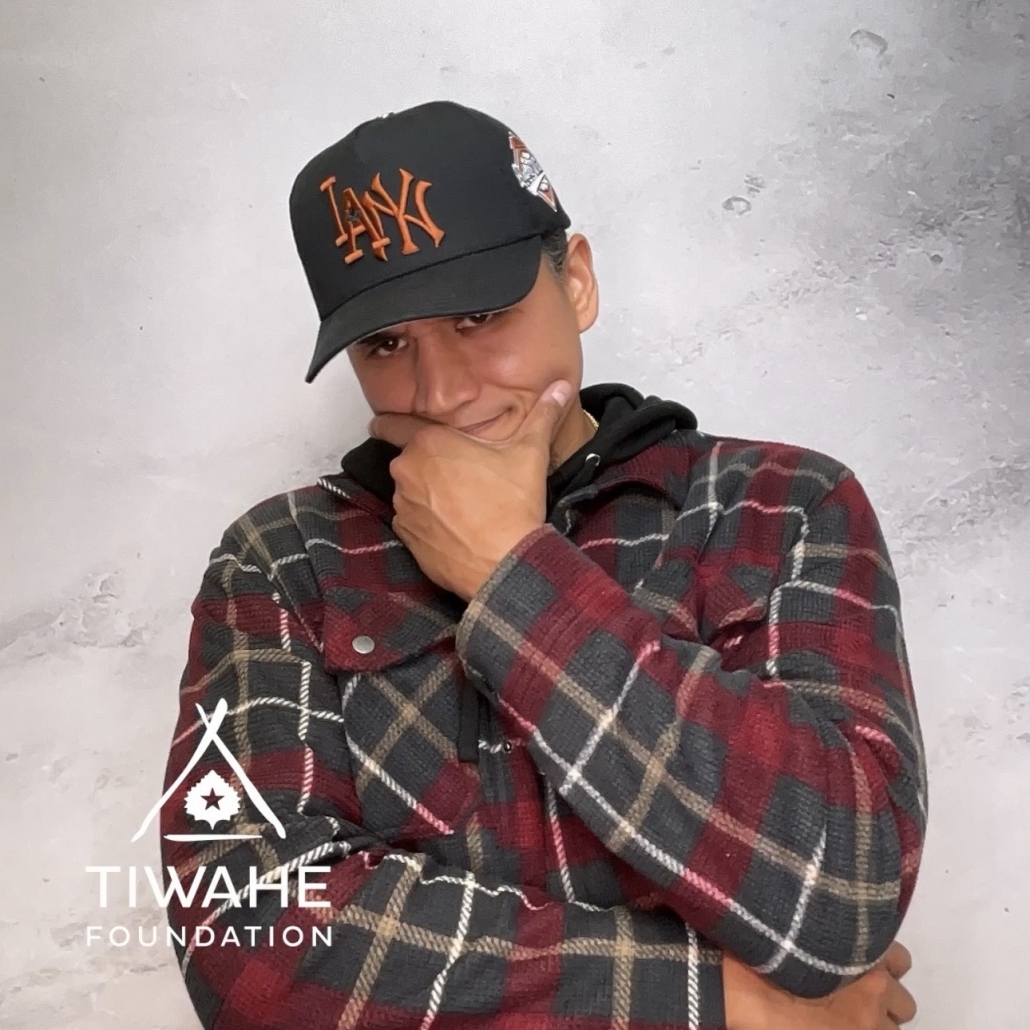
Tall Paul: Ojibwe, Rapper, Resister as Life
A First-nation view of Minneapolis today and what the USA has been all along.
Tall Paul, rap artist
Minneapolis is no stranger to civil unrest, but I wondered about the people in between, the times in between. I found Tall Paul, Ojibwe hiphop artist. Here feels like a good moment to remind everyone that Folk is music of the people, for the people, which in my eyes includes rap and punk. Tall Paul has used his vehicle to update history in projects like The Story of Jim Thorpe.
deb Ewing (dE): So how did you decide that hip hop was the vehicle for you, for your message?
Tall Paul (TP): It just kind of decided itself. I was drawn to hip hop from a young age. It was, for better or worse, the only kind of music being played in my house. Just my brothers, cousins, their boyfriends, that’s what I was exposed to. So I was drawn to it. As I got older, I started experimenting with writing raps, then freestyling for friends and at house parties.
There came a point in time where I started making better decisions. As a young man, I got into partying hard and alcoholism, but there came a point in time when I got sober. I needed to find constructive things to do with my time. So I picked up music as a means of expressing myself in a more real way. In studios, on stages, I started doing it for real. And just me being who I am, especially the younger me, learning about everything going on in the world.
And I still feel this way today, just being very passionate about people having the right to be treated like humans, not like objects or not commercial assets and so on. So I just naturally gravitated toward rapping about that kind of stuff.
I think of a song that I have called ‘Pieceful Revolution.’ A lot of people in the world have been dealing with what many people in the world are just now dealing with for the first time. You don’t have to imagine it anymore what other countries are going through, because we’re not safe in our own neighborhoods. They’re trying to desensitize us to that fact and normalize it. On two, three different occasions in the past five, six years in Minnesota, we’ve seen military vehicles going through our streets, which is kind of surreal. But I’ll admit, it is becoming a little bit desensitized even in my own psyche.
Growing used to it, and that’s not good.
me: No, it’s not.
TP: So yeah, I talk about a lot of these things in my music. I’m not somebody who raps only about this stuff, but it is a part of who I am and how I think. I’ll definitely express my thoughts and opinions on many of these things that have been going on. I wrote and recorded a new song that is specifically about the ICE occupation of Minneapolis and how it’s impacted native communities here.
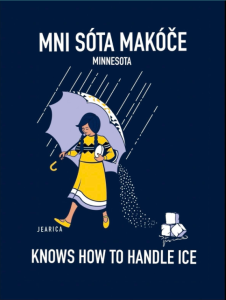
Graphic by @jearicafountain_designs
dE: How has it impacted native communities here?
TP: I mean, the impacts on Native communities: they’ve actually arrested Native community members and supposedly mistaken them for “illegal immigrants.” But really just trying to detect fear and make people afraid of them, period, whether we’re Native or not. I know there was a story about four Lakota community members who were apparently arrested. What I read is that one was released and the three other were not bound or accounted for. And there seemed to be some confusion about some of the facts around that whole situation. I still have not seen anything about them locating those community members.
dE: Neither have I.
TP: So that’s concerning. But then there was a Red Lake descendant who was arrested and brought to the Whipple building, but then they let him go. After he was let go, they put a warrant out for his detention again, so he had to turn himself in. They’re just playing games like that.
And there have been other incidents, stories of ICE agents seeing people’s tribal IDs and saying that they’re fake, “Oh, that’s not real,” and so on. Those are ways in which it has impacted the Native community. Now, I guess the bright side of it, if there is one, is that the community came together in ways that it never has come together before, and that’s speaking for Minneapolis entirely – neighborhoods organized down to individual blocks citywide – it’s pretty powerful. Obviously there’s a lot of complexity that goes into that: trust-building and so many things.
dE: It seems like trust has been having to be built very quickly where usually it takes a lifetime. It seems like there’s a lot of mistrust that might have to be undone also.

Tall Paul meets Leonard Peltier in Minneapolis
TP: – because there’s a long history of the US (government) infiltrating movements and people are aware of that. With how sudden this whole situation was, and how sudden the organizing had to happen, I’m sure that’s on the back of people’s minds at the very least. There are entire channels of communication in which they warn before you join them, like: “Hey, this is unvetted, so move with that information in mind. Don’t say anything you wouldn’t you wouldn’t want read back to you in the courts; be careful.”
dE: That’s good that people are thinking of it at that level. You talked about the household you grew up in: brothers, cousins, boyfriends. So did you have a large family living together? What’s your family organization look like?
TP: Alright, growing up was different than it is now. I mean, that comes with time, right?
Growing up, I remember it being my grandma – she’s at the top of the food chain. I remember this house in particular, I think it was a three-bedroom house, and at any given time, there might be 15 of us in the house at the same time. My grandma, then some of her kids would be there sometimes, but they were adults at the time, 20s, 30s, then their kids, which was us and our cousins. That was the dynamic much of my childhood.
For the most part, we’ve all grown up and kind of branched off into our own households. We still get together at family gatherings; that was always big. My grandma would host big dinners, and most of us would already be there because we lived under her household. But without that central matriarchal figure, that has kind of transitioned to one of my aunties. Now we all usually meet up at her house and do gatherings there, whether it’s for a holiday or just springtime coming, being warm outside and whatnot. Yeah, I do have a big extended family, and we try to get together several times a year to just have a good time, socialize, eat.
dE: You said that not all of your music is about protest, necessarily. What other topics do you cover?
TP: My Native identity is a big one. In a lot of ways, I guess you could say that just even in writing about being Native, the protest comes out of that. It comes out of a central part of who we are, having to resist, having to fight back, dealing with injustices all the time. But another that I find in my music is sobriety, which is also a big theme in my life.
dE: That’s kind of a protest too in a way. Can you talk about how you decided to perform in public? What did that look like?
TP: I can lay the background for that. So I went to like 30 different schools, kindergarten through 12th grade, and a lot of that was a result of foster care, but also just housing instability and mom being in abusive relationships that we’d have to get out of, so we’d move into a shelter. So over time, that turned into me being introverted and not very outspoken. I was probably one of the quietest kids in my entire high school of 2000 students.
Never would’ve imagined that I’d be on stages being a voice, but that’s just kind of how it worked out. So when I started making music, started making my first records and hearing myself on record, I was just mesmerized by that, showing it off to family and friends, just excited.
But then right away, people started saying, “All right, you made the music. Now what are you going to do next? You got to get on stage. That’s the next evolution of this path. You have to get on stage and become a performer.” And I hadn’t thought that through.
Somebody just kind of framed it like, “Yeah, you can’t just be a MySpace rapper.”
I was like, “Man, I ain’t no punk. I’m going to get on stage. I ain’t scared, whatever.” Just kind of that ego coming in. And so I signed up for an open mic at the U of M where I was in college at the time and probably the biggest open mic in the state. I don’t know why I would choose that for my first open mic.
dE: Nice. Well, get it up.
TP: Tall Paul: Right? Dive right in. That’s what I did. I dove headfirst into an open mic with 300 people in the audience. And I was sitting there in the seat thinking to myself like, “Man, I could just leave right now.” Nobody would notice. They’d call my name and I just wouldn’t come down and they’d go to the next person. I’m sitting there psyching myself out like that. I was like, “No, I can’t do that. I’m here to do this and here to be courageous and just face my fear.” And also to venture out on this path of becoming an artist because this is what I care so much about and it can’t progress if I don’t do this.
Well, sure enough, they called me to the stage, and I go up there and perform one of the very first songs that I ever recorded.
It was called “Spontaneous Combustion.” I had no knowledge of stage presence. So I got up there and I was kind of standing still. I was kind of looking down a little bit, but I was rapping really hard. I was so focused on just rapping, rapping my ass off. And I rapped so hard that I started running out of breath.
I messed up a little bit, but after I recovered from that mess up and got through the rest of the song okay, I was like, “All right, I got this. I can do this. This is something I can do.” So in that moment, I proved to myself that there was not anything really to be afraid of and to just push through that and make it happen.
It led to me doing this full-time now.
dE: I was listening a little bit before we connected here to “Prayers in a song,” which is your song that’s got actually Ojibwe lyrics in it, correct? How did you decide to do that?
TP: Yeah. So that one, my senior year came around and I was enrolled in a two-year Ojibwe language course. For me, I was struggling to even really have the true desire to do all the work that comes with a language like Ojibwe. It’s one of the most complex languages to learn; you have to really immerse yourself into it, which is probably the case with all languages, right? But my idea was if I can rap in Ojibwe in a song and put that out into the world, it introduces the language to a new art form and a new medium, which can be more appealing to younger ages when you’re more likely to just soak things in. So that was my senior project: create a language revitalization tool that is also attractive to the youth so that they can familiarize themselves with the language in an entertaining way.
dE: Do you think you’ll do more of that?
TP: I might. Maybe later it’ll feel right to get into that lane of making more music that’s heavily in the language. I’ll have to do some more learning of the language if it gets there. That’s probably the biggest barrier to me doing that – I just have not learned enough.
dE: Your part might just be to convince somebody younger to study and carry it from there. That would be great. I feel like language is one of the major ways to preserve a culture and a community, so I’m always very interested in efforts to preserve language.
TP: I like what you just said about culture and language, because something that’s often said in our communities is that you can’t have language without culture and you can’t have culture without language. I learned from experience that so much of the culture lives within the language. So it’s like the language is the house of the culture.
dE: When we started out here, you said “desensitization.” That word, I think, is really important.
TP: It makes you realize, honestly, that you just existing as a brown person can be like a form of activism. Not by choice, but just in this society, it’s like you have to be.
I wrote this song as part of a collective project called Right 2 Remain, focused on creating ICE protest art in various mediums, with the goal of educating, raising awareness, and providing resources. This song will have an animated music video and it will provide a QR code at the end that links to various information, resources, etc. Other projects from our collective will serve the same purpose.
Follow Tall Paul on Instagram, Facebook, Threads, X, or most any platforms as @TallPaulHipHop, so you can catch the video when it’s released, hopefully around April 21st. Watch this space for updates!
 debora Ewing writes, paints, and screams at the stars because the world is still screwed up. She improves what she can withmusic collaboration, peer-review atConsilience Poetry Journal, or designing & editing books forIgneus Press. Follow @DebsValidation onX andInstagram. Read her self-distractions atFolkWorks.org andJerryJazzMusician.com.
Tall Paul: Ojibwe, Rapper, Resister as Life
A First-nation view of Minneapolis today and what the USA has been all along.