
Preserving the Heart of Ruhnu Island
NUMBER 45 - Sounds and Stories of Ruhnu Island is a band dedicated to a unique legacy
March 2026
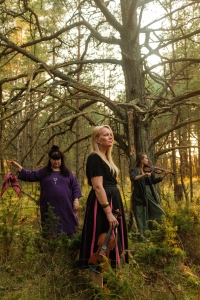
Ruhnu Music – Kairi Leivo, Karoliina Kreintaal, Lee Taul
Karoliina Kreintaal, Lee Taul, and Kairi Leivo could be found on almost any floor of the Sheraton Canal Street during Folk Alliance 2026. They were bringing the history of Ruhnu Island to the world. Their interdisciplinary project, Sounds and Stories from Ruhnu Island celebrates the unique history of an island with rich cultural and musical heritage lost during World War II.
Ruhnu, also known as Runö in Swedish, is a part of Estonia – 11.9 square kilometers of land surrounded by the Gulf of Riga in the Baltic Sea. The island is currently inhabited by about 60 permanent residents. For centuries, Ruhnu was home to a community of Swedish seal hunters known as “aibofolke” (island people) with distinctive language, traditions, music, and a reverence for exceptional fiddle players.
In August 1944, war came to Ruhnu Island. It was the last Estonian territory to be taken by the Soviets. The property of the former owners was declared property of the state. With the exception of two families, everyone fled to Sweden. Ruhnu was eventually repopulated by Estonian civilians.
The collective farm (kolkhoz) period on the island (1949–70) was a shift from fishing and sealing. Economic and cultural development became steady, though the agricultural trend in the first years of the collective farm did not justify itself.
In 1991, Estonia regained independence. Properties and assets on Ruhnu Island were rightfully restored to the owners or descendants with claims predating Soviet occupation, many of whom resided in Sweden. Not everyone chose to move back, but families still return and reconnect with the island’s legacy of storytelling, music, and songs.
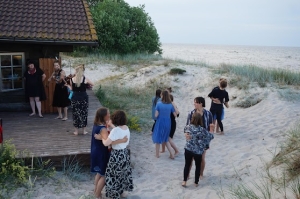 The Ruhnu Fiddle Camp, now in its 13th year, was established to revive the musical heritage of the original islanders. The emphasis on preserving Ruhnu’s traditional music is strong but also leans into the future by inviting world-class musicians to the island – this year it’s fiddler Mats Edén and flutist Jonas Simonson. Karoliina Kreintaal, Lee Taul, and Sänni Noormets teach fiddle and music; Leanne Barbo teaches traditional Ruhnu dances.
Musicians as young as age 12 are invited to apply for the XIII Ruhnu Fiddle Camp, taking place July 1-7, 2026. The website says “instrument playing level is not the most important here, and you can also participate with other chromatic instruments.” Campers sleep on the floor of the school building, with the option to camp in the school area or stay at a nearby tourist farm. The ferry from Pärnu on the mainland to the island takes a little over three hours. The camp is free (except meals) for island residents, but they should also fill out the application. Applications are open until March 15th, 2026.

The band Sounds and Stories from Ruhnu Island was formed as a direct result of the fiddle camp. They released their second album, Echoes of the Sea, in 2025 to honor the 80th anniversary of the exodus to Sweden in 1944. Have a listen here, then consider buying the music next Bandcamp Friday (the first Friday of every month) at soundsandstoriesfromruhnuisland.

debora Ewing writes, paints, and screams at the stars because the world is still screwed up. She improves what she can with music collaboration, peer-review at Consilience Poetry Journal, or designing books for Igneus Press. Follow @DebsValidation on X and Instagram. Read her self-distractions at FolkWorks.org and JerryJazzMusician.com.
Preserving the Heart of Ruhnu Island
NUMBER 45 - Sounds and Stories of Ruhnu Island is a band dedicated to a unique legacy
March 2026