
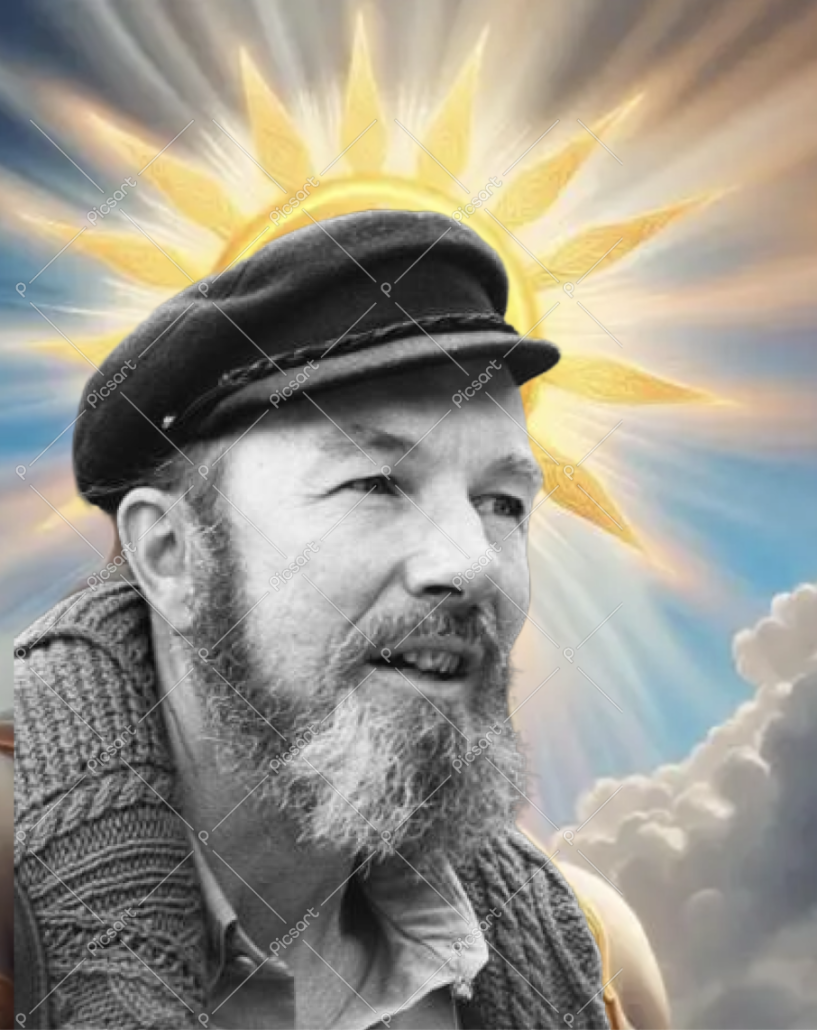
Pete Seeger, Public Enemy
Don't let this OG's chunky, funky, hand-knit sweaters fool ya.
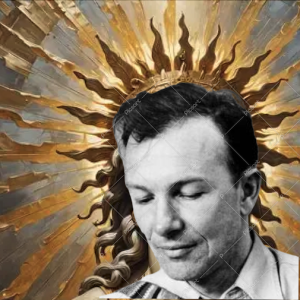
Pete’s light burned bright. Original digital art by Victoria Thomas
Had the mighty Pete Seeger not been cremated in 2014, he’d be rolling in his grave.
Old enemies persist. Among them, the Trump dynasty. Several decades ago, Pete’s pal Woody wrote some of his most tart lyrics about the notorious Queens slumlord Fred Trump, who sired our current POTUS. In fact, Guthrie rented from Trump senior in Brooklyn, and wrote “Beech Haven Ain’t My Home” and “Trump Made a Tramp Out of Me” about the misery.
One is reminded of the lyrics to the anonymous folk classic Winnsboro Cotton Mill Blues, which Pete made famous:
When I die
Dont’cha bury me at-all,
Hang me up on the factory wall,
Place a (bobbin) in my hand,
So I can keep on a-workin’ in the promised land…
Replace the “bobbin” with “banjo” and it’s pure Pete.
Just as political cartoonists have a field-day caricaturing the current President’s appearance, Pete would be in hog-heaven chronicling Trump’s daily shockers.
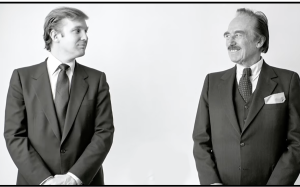
Like father, like son, the Trump dynasty provides folk fodder. Photo: Wikimedia Commons
He never shied away from skewering officials in office. Dear Mr.President was written by Seeger for FDR in 1942 right after the bombing of Pearl Harbor, recorded with the Almanac Singers. In 1952, he recorded Woody’s Dear Mr. Eisenhower, taking Ike to task for his mishandling of the Rosenberg case.
In 1970, Pete released Last Train to Nuremberg in response to the 1968 My Lai massacre where US troops failed to locate any Viet Cong troops or men of military age and according to US military eyewitness accounts raped girls as young as 10, murdered 500 unarmed civilians–children, women and elders– then burned the village to the ground to destroy the evidence. The harshly barked lyrics called out President Richard Nixon:
Would the man they came to see
Say he was too busy?
Would he say he had to watch a football game?
This taunting line references Nixon’s decision to watch the Ohio State vs. Purdue game on television, November 15, 1969, as hundreds of thousands of protestors convened in Washington, D.C. as part of the Moratorium to End the War in Vietnam.
Lieutenant William Calley who led the attack served three and a half years under house arrest, thanks to Nixon interceding on his behalf to commute Calley’s original sentence of life imprisonment with hard labor.
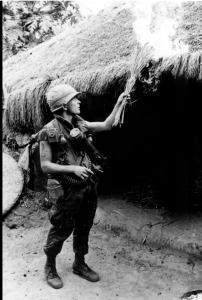
US soldier sets a “hooch”– thatched home– ablaze at My Lai. Photo: Wikiimedia Commons
But perhaps Pete’s most scathing Presidential attack had come a few years earlier in 1967 with his unflinching antiwar anthem Waist Deep in the Big Muddy. Although unnamed in the lyric, Big Muddy of course references President Lyndon Johnson’s push for escalation in Vietnam in spite of growing resistance on both sides of the aisle: “The big fool says to push on.”
The song got Pete bounced off the Smothers Brothers Comedy Hour in 1967, but Tom and Dick prevailed and Pete performed it on-air in February 1968. It’s included in his 1968 album Waist Deep in the Big Muddy and Other Love Songs.
Pete’s political outrage manifested with equal force regarding his eco-warrior advocacy for the protection of the earth. Even his most familiar (and gentlest) antiwar song references the botanical: Where Have All the Flowers Gone?
His sloop, the Clearwater, drew international attention to the troubled Hudson River which was part of Pete’s Beacon, NY landscape and incidentally launched the career of the young Don McLean. Pete sang dozens of songs about coyotes (which we now know to be anything but endangered), blessed grass that grows through cement, and the bulldozers threatening Elysian Park in Los Angeles.

Pete and Arlo Fight tha Power. Photo: Wikimedia Commons
One can only imagine the beads of leftist sweat that would form on Pete’s patrician yet populist brow to consider the present administration’s dismantling of the National Center for Atmospheric Research (where impacts of global warming were previously documented); eliminating information and stripping language from the EPA which links global warming to human activity; banning terms including “climate change” and “carbon/CO2 footprint” from Department of Energy communications; the new requirement that experimental energy projects researching the effectiveness of wind and solar power match the per-acre energy output of fossil fuels in order to qualify for funding; and more.
WWPD (What Would Pete Do)?
He’d plotz.
And given the absurd and obscene international events of the first days of 2026, he’d be on the White House steps right now. Pete was always possessed by what US Congressman John Lewis called “good trouble.”
To keep things in perspective, Pete Seeger is one of the reasons many people recoil from the folk scene. He was high-minded, high-handed, and confrontational. Virtue-signaling wrapped in an avuncular, Mr.Rogers-like persona.
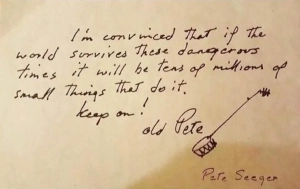
We Shall Overcome. Photo: Wikimedia Commons
He was also an unapologetic moralist and reformer, joining the Young Communist League in 1936 and the Communist Party USA in 1942.
In our era of self-branding, it is impossible to look at his painfully earnest photos from those years and not wonder if he deliberately styled himself after a slightly warmer-and-fuzzier Lenin.
Then, TBH, those sweaters, many knitted by his wife Toshi. They were the People’s Sweaters, folk sweaters, imperfect, knitted with thick yarn on thick needles, wabi-sabi, warty, knotty, knobby, bumpy, lumpy and chunky as a sack of homemade hippie trail mix.
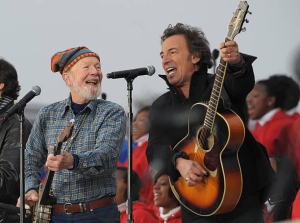
Pete and The Boss, Lincoln Memorial. Photo: Wikimedia Commons
Like a crazed desert ascetic, Pete wore them until the sprung elbows gave way and the neckline unraveled. He often topped his ‘fits with a kooky, floppy stocking cap or, more appropriately, a well-worn worker’s cap like that worn by Tevye the Milkman.
Even lefties of a certain sort remind us that Pete was not, as we say in the Bronx, from hunger, unlike Woody. Pete’s grandfather Charles Sr. was a well-educated, mercantile entrepreneur with links to the sugar and rubber industries, who made a fortune thanks to his role in the modernization of Mexico City. Pete’s parents were comfortable, lettered academics with ties to Juilliard. Let us remember that the beloved tune Freight Train by Elizabeth “Libba” Cotton came into the public consciousness because Cotten worked as a domestic in the Seeger home. Oh, to be a fly on that wall!
Was Pete pushing back against privilege? Was it all a bit “extra,” a bit of a radical-chic costume drama? Perhaps. And perhaps young Bob Dylan followed his lead, himself the scion of a middle-class family of Hibbing, Minnesota that owned an appliance rental store. Young Bob was often sent to collect on and repossess washers and stoves, a role he despised, recounted in his classic Maggie’s Farm. Bob also donned the garb of the common laborer, complete with Fiddler-esque cap.
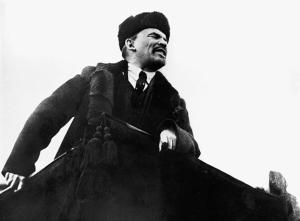
Fellow workers! Vladimir Lenin makes a speech in Red Square on the first anniversary of the Bolshevik Revolution. Photo: Wikimedia Commons, public domain
But it doesn’t matter.
Pete paid dearly for his views. He became a prime target for the House Un-American Activities Committee (HUAC) and in 1961 was convicted for contempt of Congress when he refused to “name names.” He was blacklisted for a decade and surveilled by the FBI for 20 years.
Said with utmost respect, can Public Enemy really say the same? Yo, I spent my Wonder Years in the 516/11575, 11 Cottage Place, Nassau County, Roosevelt, L.I, NY, the crew’s hood, and lemme tell ya, it was no sock hop, no Kennedy clambake. The mere passage of time has allowed this hip hop crew and all the others to name names, starting with their own: “Public Enemy.” And yes, their incendiary cuts do make Pete’s outcry seem a bit tame.
But today, while plenty of artists get into trouble with the law here in the USA, it’s usually for gross abuses of personal power versus their political views.
Pete DID “fight the power” when it was not at all fashionable to do so. He sacrificed his comfort and risked his safety to speak truth to Tha Man , even if his five-string tenor righteousness may seem a bit dated to Gen Z ears today.
Looking back over his prolific life, what is most remarkable about Pete Seeger was not his zeal. It’s his enduring relevance as a cultural truth-teller.
Most amazing of all: he ripped into corrupt and deceitful administrations and their death-dealing falsehoods without ever losing his genuine and deeply abiding love for human beings. Few of us can wield both the sword and the flute with so much grace.
 About the author: Pop culture gadfly Victoria Thomas writes for www.localnewspasadena.com and other periodicals. Reach her at victoria@hyperfire.com
Pete Seeger, Public Enemy
Don't let this OG's chunky, funky, hand-knit sweaters fool ya.