
The Woody Guthrie Center
Woody and Phil and Tom
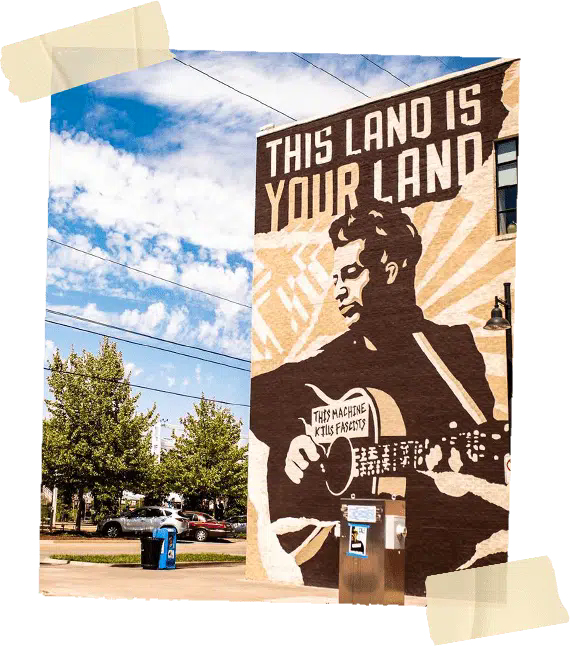
 The myth and music of Woody Guthrie belong to the world, but he will always be associated with Oklahoma. He was born there and, throughout his life, cultivated an Okie sensibility and persona. This is interesting because Woody spent most of his life living elsewhere—Texas, California, and for many years in New York City. Most of all, Woody was a traveler, a troubadour, a person who moved around the country connecting with its people. Given his Oklahoma roots and lifelong devotion to the state, it is wholly appropriate that the Woody Guthrie Archives are housed in Tulsa, Oklahoma.
The Woody Guthrie Center includes both a museum, with a permanent exhibit about Woody, and rotating exhibits that reflect the life and values of Guthrie, the American people, and folk music. The second component is the archives. The archives are not open for casual wandering; much of the material is fragile and cannot withstand regular handling. Moreover, the archives contain far more than Guthrie’s own material—though that is substantial. They also include extensive materials and artifacts related to Phil Ochs, Tom Paxton, and others.
I had the opportunity to review about a dozen of Tom Paxton’s notebooks, containing page after page of song lyrics, most of which were never recorded as far as I can tell. It is a treasure trove of topical and timeless material awaiting discovery and a second life through a new generation of artists and academics. Like all the archives at the Center, this material does not merely chronicle the songwriting evolution of an artist; it provides key insights into the political and social fabric of the nation over many decades.
I am particularly interested in the life, work, and music of Phil Ochs. While spending time in the archives, one of the highlights was the infamous gold lamé suit. You may know the story of the 1970 concert. During the 1960s, Phil wrote dozens of topical and protest songs to rally Americans to stop the misguided war in Vietnam, improve civil rights, and create a more just society. He became increasingly frustrated with the lack of progress. After the 1968 Democratic Convention—with its police riots and the orchestrated, undemocratic choice of Hubert Humphrey to run for president—Phil decided a different approach was necessary. He began channeling some of the Elvis Presley/Buddy Holly rock-and-roll vibe through his own political sensibilities. This culminated in a major concert at Carnegie Hall, where he appeared in the aforementioned gold lamé suit, mirroring the one Elvis Presley wore on the cover of his greatest hits album. Phil’s suit resides at the Woody Guthrie Center, and I’ve had the opportunity to see it. It truly is an iconic piece of American music and culture that resonates to this day.
A suit is just a suit, but it—and so much of the material in the archives—serves as a catalyst for considering the impact that music and culture can have on the country in the broader context of its social and political norms. The Woody Guthrie Center is a great place to ponder what Woody, Phil, and Tom are still trying to tell us today.
Ron Cooke is the author of a book of short stories and poems entitled Obituaries and Other Lies (available at Amazon); writes a well-received blog (ASSV4U.com/blog); and hosts a weekly radio show called Music They Don’t Want You to Hear on KTAL-LP in Las Cruces, NM. He is also a founding director of A Still Small Voice 4U, a not for profit supporting arts, culture and community that presents folk concerts, sponsors artists, festivals and community groups. Ron is an avid cyclist, racer, blogger, sculptor and ne’er-do-well.
The Woody Guthrie Center
Woody and Phil and Tom