
Merry (Scary) Mari Lwyd
A singing horse-skull (singing in Welsh!) wants your beer.
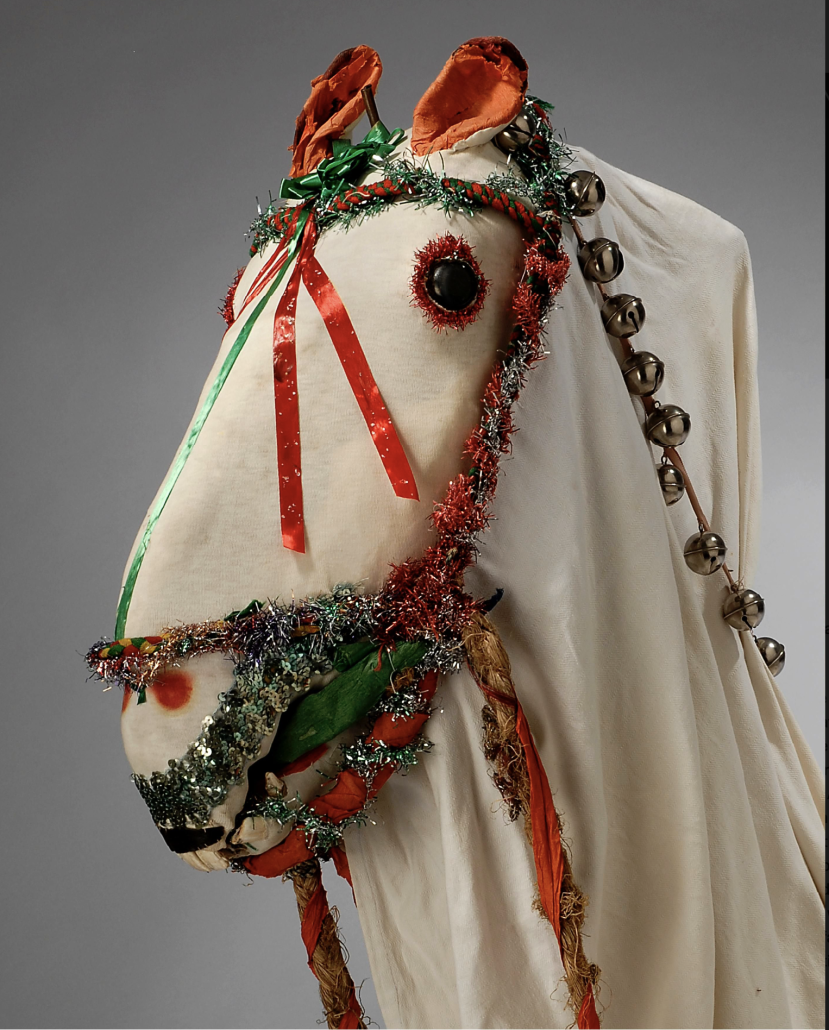
Mari Lwyd at St. Fagan’s National Museum of History, Cardiff, Wales. Used with permission.
About this time of year, we go into sugar-shock, don’t you?
And it’s not just all of that leftover Halloween candy, since sensible mums don’t let their tots roam the city streets after dusk these days. What makes my blood-glucose spike into the stratosphere is musical.
All of those blasted pa-rum-pa-pum-pums, silver bells, folks dressed up like Eskimos, Jack Frost nipping at my what? Get the F offa me! Worst of all: the Springsteen cover of “Santa Claus is Coming to Town”; no wonder The Boss got so depressed, even though it’s the most wonderful time of the year.
But a recent pre-holiday jaunt to St. Fagan’s National Museum of History in Cardiff sufficiently altered our metabolism to withstand the audio equivalent of high-fructose corn syrup.
That surprising palate-cleanser is named Mari Lwyd, pronounced more or less “Marie Lloyd” (hey, it’s Welsh, fight me). She’s an old gray mare—the more-or-less literal translation of her name—with a horse-skull set on a pole, wrapped in a household sheet. She’s the focus of the mid-winter folk tradition native to northern Wales where the Mari Lwyd is paraded around the village homes and local pubs.
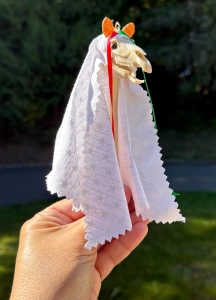
Dauntless Design Works on etsy.com creates collectible Mari Lwyd ornaments and puppets. Photo: Dauntless Design
Why so much “more-or-less”? Celtic languages are notorious for their deliberate ambiguity, Unlike Latin and German which prioritize excruciating consistency in word usage and meaning, Celtic usage is far more relative and flexible.
This becomes most interesting when discovering the Mari, since in pagan Britain as in much of the rest of the world, our ancestors believed that the period between the autumnal equinox and winter solstice was a ”thin” place in time when the barrier between the realms of living and dead became permeable. Halloween and Dia de Los Muertos, coinciding with All Soul’s Day in the old Roman Catholic church calendar, are other, more familiar signifiers of this ancient understanding
Mari Lwyd is having a renaissance, so even if you’re just learning about her right now, you’re in the know. Since you may become instantly enamored, hie ye over to etsy.com to Dauntless Design, a Bellingham, WA-based studio where makers Beccy and Jason hand-craft museum-quality Mari Lwyd ornaments, as well as a larger Mari puppet, complete with movable, jabbering jaw. Perfect gifting for every neo-pagan folk music lover on your holiday list!
Music is an essential part of the Mari experience. The lucky soul carrying the skull itself is piloted through town escorted by several singers, and trailed by progressively intoxicated local rowdies, along with children playing pennywhistles or the seljefløyte, a Norwegian harmonic flute reflecting the strong Norse presence in northern Britain.
The piloting is essential since the bearer of the skull can’t see, and must be blindly led. The costume encloses the person carrying the pole, even when a ginormous stuffed cotton horsehead is created in the absence of an actual horse skull. The collective support becomes more necessary as the night wears on, since this is indeed a neighborhood wassailing event, and one becomes increasingly unsteady upon one’s feet in the icy lanes.
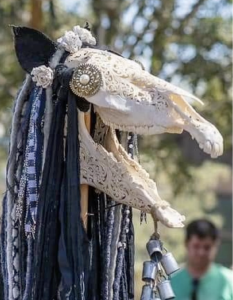
Mari Lwyd has a hinged, movable jaw for singing (and perhaps quaffing). Photo: Wikimedia Commons
The ritual of Mari Lwyd is fluid and adaptable, like all things of a Celtic nature. After being shamed into hiding for several decades by “non-conformist” (in the liturgical sense) Calvinist clergy who condemned the practice as both pagan AND Papist (bingo!), these days in Wales the equine procession usually takes place on New Year’s Eve. Of course, let us remember that Welsh New Year’s in mid-January—oh, never mind. Hobbyhorse traditions abound all over Europe, often associated with pre-Lenten Carnivale celebrations, but the dates don’t really especially matter.
What matters is those three sharp raps on your front door, usually followed by words to the effect of “Let me in!” What follows is a proto rap-battle called pwnco in Welsh. with the Mari and her posse firing off volleys of rhyming riddles and chanted couplet-challenges, similar in spirit to the African American tradition of playing the dozens. Inevitably, the hostess or host behind the door runs out of clever retorts, patience, or both, and the Mari Lwyd crew is ushered in from the cold and invited to basically eat and drink everything in sight.
In spite of her eerie (though delightfully goofy, really) presence, the belief is that a visit from Mari Lwyd ensures a year of good luck upon the house.
There is another side to the story which links Mari Lwyd to…wait for it…the Virgin Mary. Contemporary lyricist Hugh Lupton has written poignant verses to the version of the Mari archetype which explains that two millennia ago, the gray mare was simply an ordinary, pregnant, female horse about to give birth. When she was hurried out of her stall to make way for the incoming Prince of Peace, Mari Lwyd crossed over from the realm of the earth into spooky mirth.
Here’s an excerpt from Lupton’s contemporary telling:
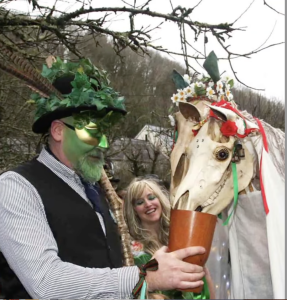
Mari Lwyd seeks welcome and a refreshing pint. Photo: Wikimedia Commons
The Mare-headed Queen,
The Mari Lwyd,
I was mother of all the heroes,
Ten thousand years my shining foals.
Bridled with starlight,
Saddled with gold,
Leapt the divide
Between living and dead,
Quickened the year
With each toss of my head.
Galloped the deep beauty
And never grew old
LET ME IN!
But Mother of God, the Mary mild
The pregnant maiden came,
Bursting with Jehovah seed
She entered my stable
And cried out her need.
With ropes I was dragged
From the birthing straw,
Aching with foal
I was heaved to the door,
Swapping warmth for bitter weather
And birth of a rival creed.
LET ME IN!
Neo-pagans will be quick to interpret this as Christianity usurping prior Celtic belief-systems. This would make sense, except that the numbers don’t track. At all. The earliest known accounts of Mari Lwyd date from the 1800s, and that’s CE, not BCE.
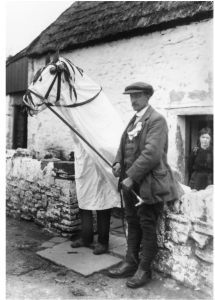
Although she seems more ancient, Marie Lwyd appears to be a 19th century stable-fable. Photo: Wikimedia Commons
Yes, horses were mythic, powerful beings in ancient Pretannike, later called Albion and Sarum. Gray horses in particular had special significance in the indigenous spiritual systems of the Celts, who believed that the beasts could cross between the land of the living and the unseen worlds.
But what’s most intriguing about Mari is her seeming modernity, mystery, secrecy. Is she too scary, too ghastly for modern tastes? Nah. She’s quite friendly as Christmas-y “altar” egos go, unlike Krampus who actively harms children, and Dr. Seuss’s Grinch, the ultimate, small-hearted killjoy.
Let us remember that prior to about 1970, few people who no se hablan Español had ever heard of, much less celebrated, Dia de los Muertos. But today, as immortalized in Coco, grinning plastic Calaveras and taunting Catrinas are mass-produced in China and sold in Target and Walmart along with our more familiar Eurocentric Halloween decorations. Could Mari Lwyd be next?
And could it be that the Welsh, mercilessly dehumanized by Anglo Saxons, simply kept her practice underground? Some sources say that, when not in use, the horse skull used in the winter parading is freed from her ribbons and bells and buried in the ground to rest and recharge for next year.
Perhaps in the same way, Mari Lwyd is now surfacing for all the world to experience her horsey blessing.
ABOUT THE AUTHOR: Victoria Thomas is a Bronx-born pop culture journalist who travels the world looking for the next great story. Will it be  yours? Find out at victoria@hyperfire.com
Merry (Scary) Mari Lwyd
A singing horse-skull (singing in Welsh!) wants your beer.